Bombas autocebantes en el desaguado minero: por qué la calidad del agua con sedimentos impulsa la elección del diseño
“Mine water is dirty” undersells the actual engineering problem by a wide margin. Different mining water sources fail pumps through entirely different mechanisms, and treating them as one generic “dirty water” category is why equipment selected for general construction dewatering routinely underperforms — or fails outright — when redeployed to a mine site. This works through what actually differs about mining water, and where that difference concentrates its impact on a self-priming pump’s most vulnerable component.
On This Page
Why Mine Water Isn’t “Just Dirty Water”
Mining operations generate at least three distinct water categories, each stressing a pump through a different failure mechanism rather than one generic “abrasive water” problem:
Tailings slurry carries a high concentration of fine mineral particles — often a much greater suspended solids load by weight than typical construction dewatering water — and while individual particle size may be small, the sheer concentration produces continuous, high-intensity abrasive contact against any wetted surface. Acid mine drainage (AMD), generated when sulfide minerals in exposed rock oxidize on contact with water and air, is a fundamentally different problem: low pH water attacks metal components chemically, corroding casings and valve components even where suspended solids content is comparatively low. Pit and haul road water picks up coarse rock fragments, gravel, and debris from blasting and vehicle traffic — a solids-passing problem more than a fine-abrasion problem, closer in character to construction debris than to tailings slurry. A pump specified for one of these three conditions can perform poorly or fail prematurely in another, which is why “mine water” isn’t a single design target.
Why Self-Priming Wins Over Vacuum-Assisted in This Specific Environment
Mine dewatering sumps rarely hold a stable water level — they fluctuate with blast schedules, shift patterns, and the pit’s excavation stage, and the pump itself is frequently repositioned as the working face advances. A vacuum-assisted priming system adds a separate vacuum pump, separator tank, and float shutoff assembly to handle exactly this kind of repeated dry-restart condition — additional components that need their own maintenance and, on a remote or open-pit site without ready access to specialized technicians or spare parts, represent a second thing that can fail independently of the pump end itself. A self-priming design’s internal recirculation mechanism has no separate component performing that function; the priming capability is built into the same casing and impeller that does the pumping, with nothing extra to service. The trade-off — slower priming on very high suction lift compared to a dedicated vacuum system — is usually the more acceptable cost on a mine site where equipment reliability with minimal specialized maintenance matters more than shaving the last minute off priming time, though that trade-off does have a real limit, covered further down.
Sediment Load and Foot Valve Wear: The Direct Connection
As covered in more detail in our foot valve wear life cycle analysis, abrasive suspended content is the dominant driver of foot valve wear rate, since every priming cycle passes turbulent water directly across the valve’s sealing face. Mining tailings and pit water routinely carry a far higher suspended solids concentration than typical construction dewatering water, which means the same progression from light to moderate to severe wear that might take an extended period in general construction duty can compress into a substantially shorter service interval under mining conditions. This has two direct, practical consequences for mining-duty equipment specifically: elastomer flapper valves, more vulnerable to abrasive surface wear, are a weaker choice here than metal-seated valve designs, which tolerate higher abrasive loading before losing sealing capability; and inspection intervals suited to general construction duty are almost certainly too infrequent for sustained tailings or pit water service, where cycle-count-driven wear accumulates faster than a calendar-based schedule would assume.
High-Head, Long-Distance Transfer: Where Self-Priming Reaches Its Limits
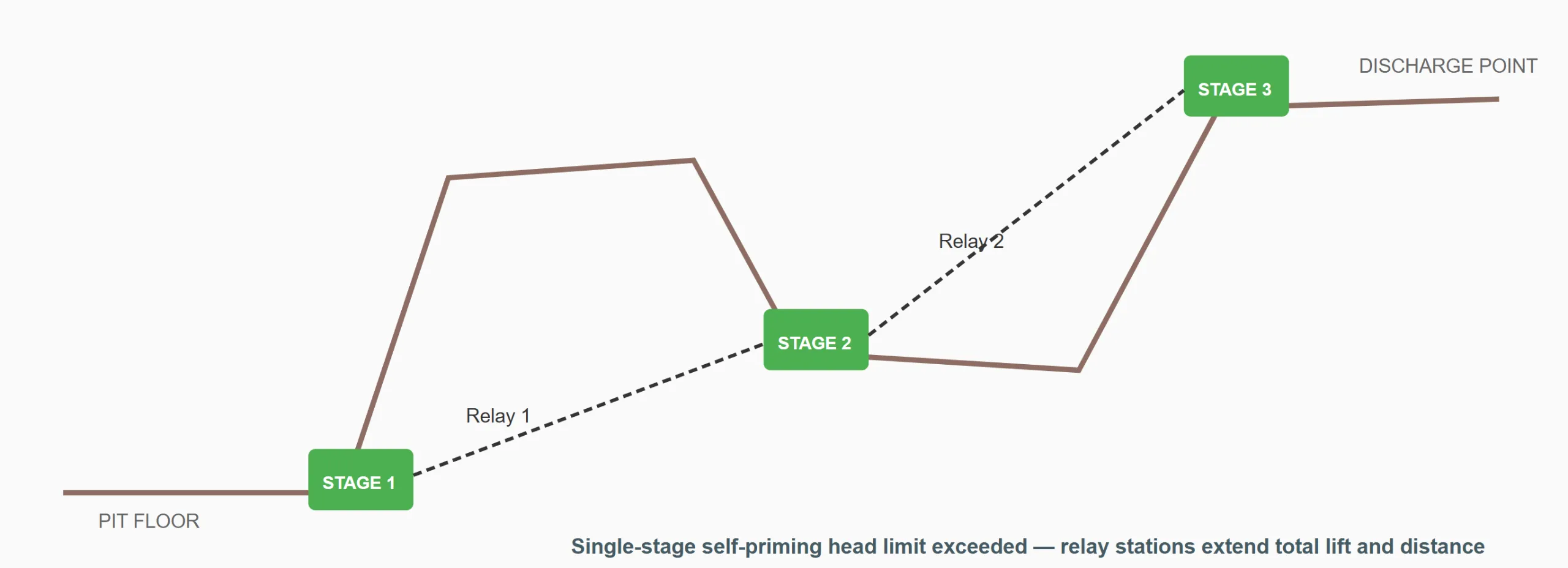
Open-pit mines frequently need water lifted hundreds of meters in static head and transferred kilometers horizontally to a discharge or treatment point — conditions that push toward the upper edge of what a single self-priming stage can practically deliver. High-head trailer mounted water pump configurations, such as our ZBCY-series units rated up to 120 meters of head, extend that reach considerably further than a standard-duty self-priming design, but even these have a practical ceiling for a single stage. Beyond that ceiling, the same series-operation principle covered in our pump curve mathematics article — stacking pump head contributions at a shared flow rather than relying on one unit alone — becomes the standard approach, using relay or booster stations along the transfer route rather than asking a single pump to generate the entire lift and distance on its own.
Both our ZBCY-series and Self-Priming Trash Pump – Trailer Mounted Pump SCPY-series lines are built to pass coarse solids — up to 75mm on ZBCY high-head configurations and up to 76mm on SCPY units — specifically because mine water rarely arrives clean even when the job calls for high head or long-distance transfer. Selecting a high-head configuration doesn’t mean giving up solids-handling capability; the two specifications are independent and both need to be checked against actual site conditions.
Duty Cycle Patterns Specific to Mining Operations
Mining dewatering generally falls into one of two duty patterns, and — per the wear timeline analysis in our foot valve and gasket life cycle article — which pattern a specific site follows determines which component is more likely to become the limiting factor. Continuous sump dewatering at an active pit face, running for extended periods with comparatively few full shutdown-restart cycles, tends to put calendar-driven casing gasket aging ahead of cycle-driven foot valve wear as the more relevant maintenance concern. Temporary or relocatable dewatering — clearing water during shaft development, or repositioning equipment as an open-pit operation advances stage by stage — accumulates far more start-stop cycles over the same calendar period, which shifts the balance toward foot valve wear as the dominant concern instead. Recognizing which pattern a given deployment actually follows is what should drive the inspection schedule, rather than applying one generic interval to both.
Frequently Asked Questions
Q: Is a self-priming pump suitable for acid mine drainage, or does AMD require different material selection entirely?
A: AMD’s low pH is a corrosion problem more than an abrasion problem, so casing and valve material selection needs to prioritize chemical resistance rather than just abrasion resistance — a component chosen purely for abrasive wear tolerance (like a hardened metal seat) may still corrode in acidic water if the base material isn’t suited to that chemical condition.
Q: Can one pump configuration handle both tailings slurry and coarse pit debris?
A: The two conditions call for different priorities — fine abrasive slurry favors hardened materials and abrasion-resistant seals, while coarse debris favors a large solids-passing rating and open impeller geometry. A unit specified for both needs to be checked against each requirement independently rather than assuming one “heavy-duty” rating covers both conditions.
Q: At what point does a mining project need relay pumping instead of a single high-head self-priming unit?
A: Once the combined static lift and friction losses over the transfer distance exceed what a single stage can generate at a usable flow rate — for very deep open pits or long transfer routes, this threshold is reached well within normal operating conditions, and relay staging becomes the standard rather than exceptional approach.
Q: Should foot valve inspection intervals be the same across all mining applications?
A: No — a unit in continuous sump duty with relatively few restart cycles wears the foot valve more slowly than one that’s frequently repositioned and restarted as excavation progresses, even in similar water quality. Inspection frequency should reflect the specific duty pattern, not a single mining-wide default.
For help matching a configuration to your specific mine water conditions, head requirement, and duty pattern, explore our mining dewatering pump solutions or contact the CANNASPRING engineering team directly.
Related Reading
- Ciclo de vida de desgaste de la válvula de pie y los sellos en bombas autocebantes
- Resolución de problemas de bombas autocebantes: Una guía de diagnóstico de síntomas a causas
- Estimación del tiempo de cebado de una bomba autocebante: Guía de cálculo práctica
- How a Self Priming Pump Works
- What Is a Self Priming Pump?
- Why Choose a Self Priming Pump?