Why choose a self priming pump?
This looks at when a self priming pump is actually the right call for a job — not what it is or how its priming mechanism works internally, which are covered separately in What Is a Self Priming Pump? and How a Self Priming Pump Works [links to be added once those articles are published]. What follows assumes you already know the basics and want the decision-making case: when to choose one, how it stacks up against the alternatives, and where its limits are.
On This Page
Key Advantages of Self Priming Pumps
- No manual priming required — the pump reprimes itself automatically after each shutdown, so operators don’t need to bleed air or flood the line by hand.
- Fast startup — crews can get water moving within minutes of arriving on site, which matters when time-sensitive dewatering or emergency flood response is involved.
- Suitable for intermittent operation — self priming pumps tolerate frequent start/stop cycles far better than pumps that require flooded suction, making them well suited to jobs where water levels fluctuate throughout the day.
- Handles air mixed with water — entrained air, which would airlock a standard centrifugal pump, is simply vented out as part of the normal priming cycle.
- Easy operation in remote sites — with no external priming equipment, vacuum pump, or foot valve maintenance required, a self priming pump system is easier to run with a smaller or less specialized crew.
This combination of self-reliance and tolerance for imperfect suction conditions is the core reason “why choose a self priming pump” so often comes down to reliability under real-world site conditions, not just theoretical performance on a spec sheet.
When Should You Choose a Self Priming Pump?
Self priming pumps are the right call whenever suction conditions are inconsistent, unattended operation is likely, or the pump needs to be moved and restarted frequently. Typical scenarios include:
- Construction dewatering — pumping out excavations, foundations, and trenches where water levels rise and fall with rainfall or groundwater intrusion.
- Flood control — rapid deployment during storm events, where the pump may sit idle between rain bursts and needs to reprime instantly when water returns.
- Municipal bypass pumping — routing flow around a section of sewer or water main under repair, often running continuously for days or weeks.
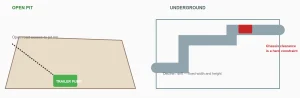
- Mining temporary drainage — clearing pit water or sump overflow in locations where suction lift varies as the water table drops.
- Remote job sites — locations without continuous operator supervision, where a pump that can lose prime overnight and recover on its own the next morning is essential.
Self Priming Pump vs Other Pump Types
| Factor | Self Priming Pump | Submersible Pump | Centrifugal Pump | Vacuum Assisted Pump |
|---|---|---|---|---|
| Suction setup | Above-ground, reprimes automatically | Submerged in the fluid, no priming needed | Must be flooded before startup | Uses external vacuum system to prime |
| Maintenance access | Easy — stays above water, accessible for service | Harder — requires pulling the unit from the sump or pit | Easy, but suction line must stay flooded | More complex due to added vacuum components |
| Tolerance to intermittent flow | High | High | Low — loses prime if line drains | High |
| Handling debris/solids | Good with solids-handling models | Good | Limited | Good |
| Setup flexibility | Can be positioned wherever access allows | Limited to submerged applications | Limited by suction lift | Flexible but adds equipment complexity |
In short: submersible pumps avoid priming issues by working underwater, but they’re harder to inspect and service mid-job. Standard centrifugal pumps are efficient but unforgiving if the suction line loses its flood. Vacuum assisted pumps solve the priming problem too, but add extra hardware and points of failure. A self priming pump strikes the balance most sites need — flexible placement, easy maintenance, and dependable restarts — without the added complexity of a separate vacuum system.
Limitations of Self Priming Pumps
- Limited suction height — most self priming pumps are rated for a practical suction lift of around 7–8 meters (26 feet) at sea level; deeper suction requires a submersible or a different pump arrangement entirely.
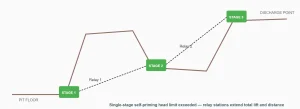
- Not ideal for very high head — self priming units are generally optimized for moderate head, moderate flow duty; applications demanding very high discharge pressure are usually better served by multistage centrifugal pumps.
- Requires proper installation conditions — the suction line must be airtight, with no leaking fittings or a damaged foot valve, or the pump will struggle to hold prime between cycles.
Understanding these constraints upfront helps avoid mismatched equipment on site, and it’s part of why proper sizing — not just picking “a self priming pump” off a catalog page — matters for project outcomes.
Industrial Applications of Self Priming Pumps
- Construction sites — general site dewatering, slurry transfer, and trench drainage during excavation and foundation work.
- Flood emergency drainage — rapid-response pumping for municipalities and disaster relief crews clearing standing water from roads, basements, and low-lying infrastructure.
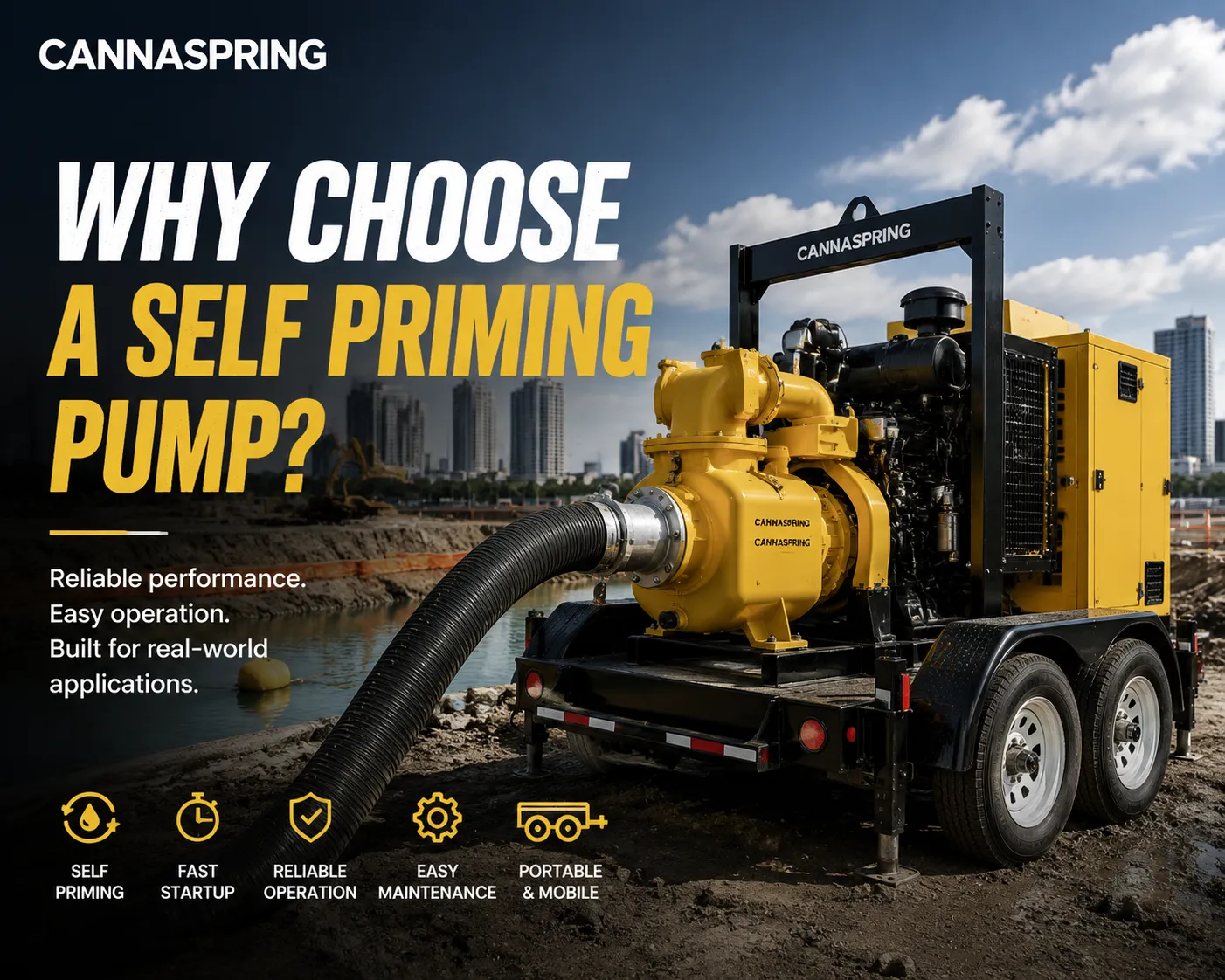
- Sewage bypass systems — solids-handling self priming pumps are used to reroute wastewater flow around sections of pipe or lift stations undergoing repair or replacement. A Self-Priming Diesel Trash Pump, such as our trailer-mounted trash pump, is built specifically for this duty, with an impeller designed to pass suspended solids and debris without clogging.
- Mining water removal — clearing pit sumps, haul road drainage, and temporary dewatering during shaft or open-pit development.
Choosing the Right Self Priming Pump for Your Project
- Flow rate requirement — how many liters per second or gallons per minute does the job actually need, based on expected inflow, not just pipe size?
- Head requirement — total dynamic head, including suction lift, discharge elevation, and friction losses across the full pipe run.
- Water type — clean water, muddy/silty water, or raw sewage each call for a different impeller design and solids-handling capability.
- Diesel vs electric — diesel units suit remote sites without grid power and offer longer unattended run times; electric units are quieter and lower-maintenance where power is already available.
- Portability — for jobs that move between locations, a trailer mounted option adds road-legal towing, integrated fuel tanks, and faster mobilization between sites.
This is also where a customizable pump unit — self-priming, centrifugal, or mixed flow — becomes useful, since not every project fits a single pump type. A pump system with a self-priming option gives you the startup reliability described above while still leaving room to match impeller and casing design to the specific flow, head, and water quality on a given job.
Frequently Asked Questions
Q: Is a self priming pump the same thing as a trash pump?
A: Not exactly — “self priming” describes how the pump recovers prime without manual flooding, while “trash pump” describes its solids-handling capability. A Self-Priming Diesel Trash Pump combines both: self-priming startup with an impeller and casing built to pass debris and suspended solids without clogging, which is why the two terms are often used together for construction and municipal dewatering duty.
Q: Can a self priming pump handle muddy or sediment-laden water?
A: Standard self priming models are built for moderate solids content. For water carrying heavier debris or sewage-adjacent solids, a solids-handling configuration with a semi-open or open impeller — as used on our trailer-mounted trash pump — is the appropriate choice rather than a standard clear-water unit.
Q: How often does a self priming pump need to be restarted before wear becomes a concern?
A: Self priming pumps are specifically designed to tolerate frequent restart cycles better than pumps requiring a flooded suction line, which is why they’re the standard choice for jobs with fluctuating water levels. Restart frequency alone isn’t a wear concern as long as the casing retains its priming water reservoir between cycles.
Q: When should I choose a vacuum-assisted pump instead of a self priming pump?
A: When suction lift or suction line length is great enough that self-priming’s internal recirculation would take too long to reprime, a vacuum-assisted system’s dedicated vacuum pump evacuates air from the line faster, at the cost of additional equipment complexity.
If you’re specifying pumping equipment for an upcoming project, contact the CANNASPRING engineering team to get a recommendation matched to your actual flow, head, and site conditions rather than a one-size-fits-all unit.