Ciclo de vida de desgaste de la válvula de pie y los sellos en bombas autocebantes
Most components in a self-priming pump only experience wear-inducing load while the unit is running. The foot valve and the casing seal are the exception — they’re under load continuously, whether the pump is operating or has been shut off for a week, and that constant-duty condition produces a wear pattern that doesn’t resemble anything else in the machine. This traces how each component actually degrades over its service life, what drives the rate, and — the part most maintenance guidance skips — how the two wear processes interact.
On This Page
Why These Two Components Wear Differently From the Rest of the Pump
An impeller, a bearing, a mechanical seal face — these components only experience the load that wears them while the shaft is turning. Stop the pump, and wear effectively stops with it. The foot valve and the casing seal don’t get that rest. The foot valve’s sealing face has to resist the full hydrostatic pressure of the retained water column sitting above it continuously, for as long as the pump exists in that state — including every hour it sits idle between jobs. The casing gasket has to maintain a compressed seal around the retained water reservoir indefinitely, under sustained mechanical load, whether the pump has run in the last hour or the last month. This produces an unusual combined wear signature: near-continuous static stress for the vast majority of the component’s life, punctuated by brief windows of intense abrasive and turbulent stress during each actual priming cycle. Neither the static nor the cyclic mechanism alone explains how these parts degrade — it’s the combination that does, and it’s a fundamentally different wear pattern from anything else in the pump.
Foot Valve Wear Progression: Three Stages
Foot valve degradation moves through three broadly identifiable stages, though the boundaries between them are gradual rather than sharp:
What Drives Foot Valve Wear Rate
Suspended sediment and abrasive content. This is the dominant variable. Every priming cycle passes turbulent, air-entrained water across the sealing face, and any suspended grit in that water acts, over thousands of cycles, like an extremely slow lapping compound working against the seat. A unit primed repeatedly against clean water can go through many times more cycles before reaching the same wear stage as one regularly primed against sediment-laden water.
Start-stop cycle frequency. Because the valve wears primarily through the act of closing and reopening rather than through elapsed running time, two pumps with identical total operating hours can show very different valve wear if one operates in continuous long-duration runs and the other cycles on and off frequently throughout each day. Cycle count, not runtime hours, is the more relevant figure for this specific component — a distinction worth tracking separately from the hour meter most maintenance schedules are built around.
Valve material. Elastomer flapper valves tend to degrade through surface abrasion progressing eventually to tearing or chunking of the sealing element itself. Metal-seated valve designs wear through a different mechanism — material transfer and galling between contacting metal surfaces — and can tolerate higher abrasive content before losing sealing capability, at a generally higher cost and, on some designs, less forgiving behavior once wear does begin (a metal seat that’s galled often needs replacement rather than the gradual performance degradation an elastomer shows on its way to failure).
Casing Seal and Gasket Wear Progression
The casing gasket sealing the retained-water reservoir degrades through an entirely different mechanism than the foot valve — not primarily abrasive erosion, but compression set and material aging, since its job is maintaining a static compressed seal rather than repeatedly opening and closing against flow.
A Combined Wear Timeline: How the Two Components Interact
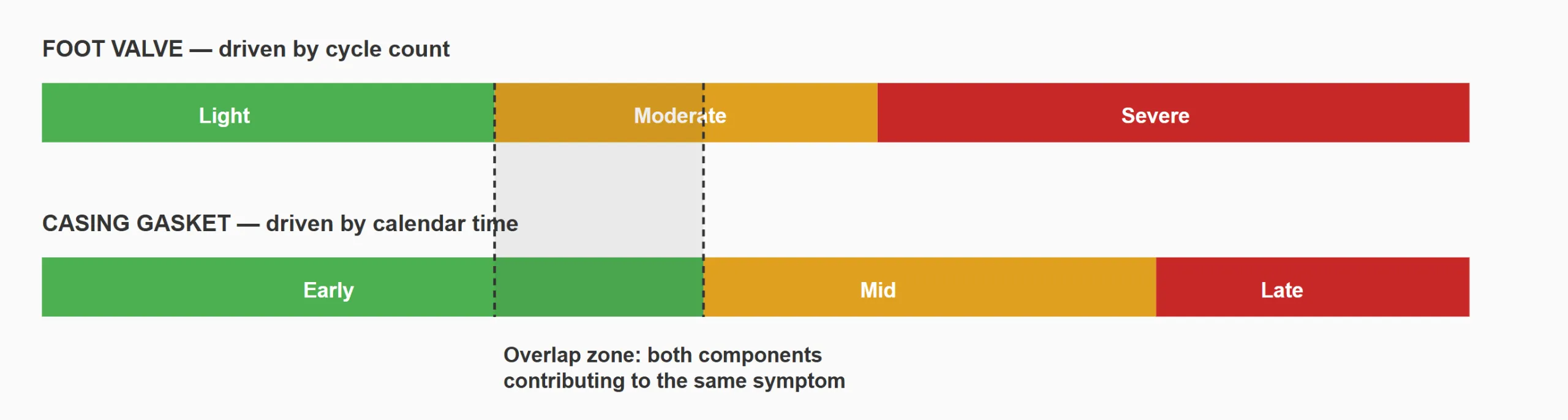
The foot valve and the casing gasket wear through different mechanisms, driven by different underlying variables — cycle count and abrasive content for the valve, elapsed calendar time and thermal exposure for the gasket — which means their wear curves don’t necessarily progress together, and the component that becomes the limiting factor depends heavily on how the specific unit has actually been used. A pump in high-frequency intermittent duty on relatively clean water may show foot valve wear advancing ahead of gasket aging, since cycle count accumulates quickly while calendar-driven gasket degradation stays comparatively slow. An older unit used in fewer, longer continuous runs may show the opposite: comparatively light valve wear despite years in service, with gasket aging as the dominant factor simply because calendar time — not cycle count — has been accumulating the whole while.
The genuinely important consequence of this is that both components can independently reach their moderate-wear stage and produce the identical field symptom — reprime failure specifically after a long idle period, with same-day restarts still working — making it effectively impossible to determine from symptoms alone which component is actually responsible, or whether both are contributing simultaneously. This is why a field diagnosis that stops at “the foot valve must be worn” without also checking the gasket risks a repeat failure shortly after the valve alone is replaced, if gasket aging was quietly contributing the whole time.
Inspection Intervals and What to Check at Each Stage
| Component | Duty Profile | Suggested Inspection Interval | What to Check |
|---|---|---|---|
| Foot valve | Frequent cycling, abrasive water | More frequent — tied to cycle count, not just calendar time | Sealing face condition, seat grooving, flapper deformation |
| Foot valve | Infrequent cycling, clean water | Less frequent, but not skipped entirely | Same checks, lower expected wear rate |
| Casing gasket | Any duty profile | Calendar-based — tied to elapsed time, not cycle count | Compression set, surface cracking, seating in groove |
| Both together | Any time reprime reliability degrades | Immediate — don’t inspect only the more “obvious” suspect | Retained water loss rate over a timed idle period, isolating which component is leaking |
Frequently Asked Questions
Q: Does frequent start-stop cycling wear the foot valve faster than continuous running at the same total hours?
A: Yes — foot valve wear is driven primarily by the number of closure cycles rather than elapsed running time, so a unit that starts and stops frequently accumulates more valve wear than one running the same total hours in fewer, longer sessions.
Q: Why does the casing gasket age even when the pump isn’t running?
A: The gasket’s job — maintaining a compressed seal around the retained water reservoir — is a continuous static load, not something tied to operation. Compression set and material aging progress on elapsed calendar time and thermal exposure, independent of whether the pump has run recently.
Q: If reprime is failing after long idle periods, should I replace the foot valve or the gasket first?
A: Both wear mechanisms can produce this identical symptom independently, so replacing only one based on a guess risks a repeat failure shortly after. Isolating which component is actually leaking — by monitoring retained water loss over a timed idle period after servicing one at a time, or inspecting both directly — is more reliable than assuming which one is responsible.
Q: Does a Self-Priming Diesel Trash Pump wear these components faster than a clean-water configuration?
A: Generally yes for the foot valve specifically, since a trailer-mounted Self-Priming Diesel Trash Pump handling sediment-laden or debris-carrying water exposes the sealing face to more abrasive content per cycle than a clean-water duty would. Gasket aging, driven by calendar time and thermal exposure rather than water quality, isn’t meaningfully affected by solids content in the same way.
For guidance on inspection intervals suited to a specific duty profile, or to confirm which component is responsible for a reprime issue before ordering parts, contact the CANNASPRING engineering team.