What Is a Self Priming Pump?
This is a definitions-and-classification reference — what a self-priming pump actually is, where it sits in the broader pump family, and how the terminology around it is used. For guidance on when to choose one over the alternatives, see our separate Why Choose a Self Priming Pump? guide; for how the priming mechanism itself operates internally, see our upcoming How a Self Priming Pump Works article.
On This Page
- Defining a Self-Priming Pump: The Core Distinction
- Where Self-Priming Pumps Fit in the Broader Pump Family
- Key Physical Components That Define a Self-Priming Design
- Common Terminology: Self-Priming vs Dry-Prime vs Vacuum-Assisted
- Common Configurations and Form Factors
- A Brief Origin Note
- Frequently Asked Questions
Defining a Self-Priming Pump: The Core Distinction
A self-priming pump is a centrifugal pump capable of evacuating air from its own suction line and re-establishing flow without an operator manually flooding the casing and line beforehand. The defining distinction is against the standard centrifugal pump: a standard centrifugal design requires its casing and suction line to already be filled with liquid before it can generate flow, since the impeller has nothing to act on but air otherwise. A self-priming design removes that precondition — it can start from a dry casing and suction line and reach full flow on its own. This single capability is the entire basis of the “self-priming” classification; everything else discussed below is a consequence or variation of it, not a separate defining trait.
Where Self-Priming Pumps Fit in the Broader Pump Family
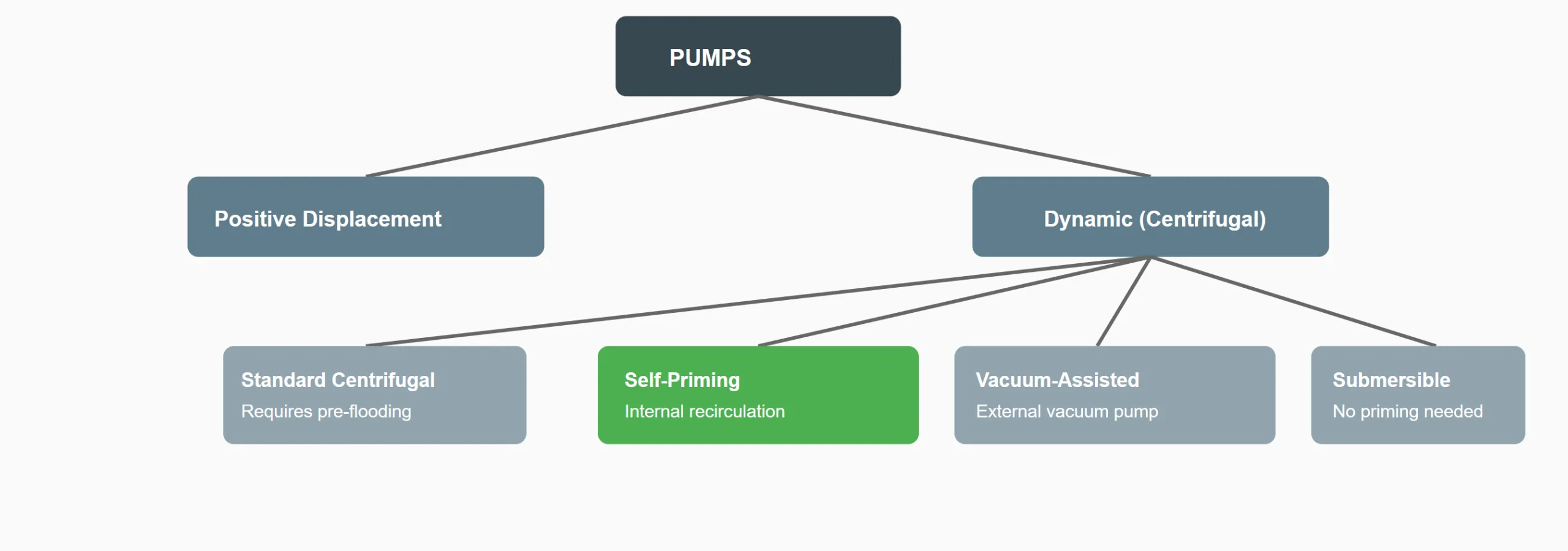
Pumps split first at the broadest level into positive displacement designs (diaphragm, piston, and similar types that move a fixed volume per cycle) and dynamic designs (centrifugal and related types that impart velocity to the fluid). A self-priming pump sits entirely within the dynamic, centrifugal branch of that split — it is a variant of centrifugal pump design, not a separate pump family alongside it. Within the centrifugal branch, the classification then depends on how the pump handles a dry suction line at startup: a standard centrifugal pump handles it not at all (it must be pre-flooded), a self-priming pump handles it through internal air-water recirculation, a vacuum-assisted (dry-prime) pump handles it with a dedicated external vacuum pump, and a submersible pump avoids the question entirely by operating with its impeller already underwater.
Key Physical Components That Define a Self-Priming Design
A self-priming pump is physically identifiable by a small set of components a standard centrifugal casing doesn’t have. An enlarged casing reservoir retains a volume of liquid between shutdowns rather than draining fully. A dedicated separation chamber, cast into the pump body, is shaped to handle the internal recirculation process the priming cycle depends on. A check or foot valve at the suction inlet prevents retained casing water from draining back down the suction line when the pump is idle. Naming these parts is enough to identify a self-priming design on a cutaway drawing or spec sheet — how they work together during the actual priming cycle is a mechanism-level question covered separately.
Common Terminology: Self-Priming vs Dry-Prime vs Vacuum-Assisted
These terms get used inconsistently across the industry, which is worth untangling on its own:
| Term | What It Refers To |
|---|---|
| Self-priming | A pump that reprimes using its own internal casing reservoir and recirculation, without external equipment |
| Dry-prime | A general description of any pump’s ability to start from a dry suction line — used loosely to describe both self-priming and vacuum-assisted designs |
| Vacuum-assisted | A specific dry-prime method using a dedicated external vacuum pump to evacuate suction line air, distinct from self-priming’s internal recirculation method |
“Dry-prime” is the broadest, least precise term of the three — it describes an outcome (starting dry) rather than a specific mechanism, and is sometimes used by manufacturers to refer to either self-priming or vacuum-assisted equipment interchangeably. “Self-priming” and “vacuum-assisted” are the two mechanism-specific terms, and they refer to genuinely different hardware.
Common Configurations and Form Factors
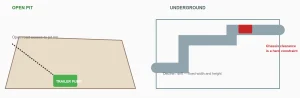
Self-priming pump ends are built into several common physical configurations. Stationary or skid-mounted units sit on a fixed base for permanent or semi-permanent installation. Trailer-mounted units pair the pump end with a towable chassis for mobile deployment between sites. Drive source varies independently of mounting type: diesel-driven units run from an onboard engine, suited to sites without reliable grid power, while electric-driven units run from a motor connected to available power supply. A Self-Priming Trash Pump — a self-priming design built with a solids-passing impeller and abrasion-tolerant casing — is a distinct configuration variant within this family, built specifically for water carrying debris or suspended solids rather than clean water. Our trailer-mounted Self-Priming Trash Pump line combines the trailer-mounted, diesel-driven configuration with this solids-handling design variant.
A Brief Origin Note: Why Self-Priming Design Was Developed
Self-priming centrifugal design emerged as portable, engine-driven pumps became standard field equipment over the mid-20th century, in military engineering and construction contexts where a pump needed to be dropped at a water source and started reliably by whoever was on hand — not necessarily a trained pump operator familiar with manual flooding procedure. A standard centrifugal pump’s requirement to be pre-flooded before every start was workable in a fixed industrial installation with dedicated staff, but impractical for equipment that needed to be repositioned frequently and restarted without specialized attention. The self-priming casing design solved this by moving the priming procedure inside the machine itself, and that same requirement — reliable, unattended restart in the field — remains the reason self-priming design remains the default for mobile construction, municipal, and industrial dewatering equipment today.
Frequently Asked Questions
Q: Is “self-priming” the same thing as “dry-prime”?
A: Not precisely. “Dry-prime” is a general description of starting from an empty suction line, and is sometimes applied loosely to both self-priming and vacuum-assisted pumps. “Self-priming” refers specifically to the internal recirculation mechanism, distinct from a vacuum-assisted design’s external vacuum pump.
Q: Is a self-priming pump a different type of pump from a centrifugal pump?
A: No — a self-priming pump is a variant of centrifugal pump design, not a separate category alongside it. All self-priming pumps are centrifugal pumps; not all centrifugal pumps are self-priming.
Q: What physically distinguishes a self-priming pump casing from a standard centrifugal casing?
A: An enlarged reservoir that retains liquid between shutdowns, an internal separation chamber built for the priming recirculation process, and a check or foot valve preventing that retained liquid from draining back down the suction line when idle.
Q: What is a Self-Priming Trash Pump specifically?
A: A self-priming pump built with a solids-passing impeller design and abrasion-tolerant casing material, intended for water carrying debris or suspended solids rather than clean water — a configuration variant within the broader self-priming pump family.
For guidance on matching a specific self-priming configuration to your project conditions, contact the CANNASPRING engineering team.