Hurricane Readiness Why Your Choice of Trailer Pump is a Strategic Decision
The Meeting You Don’t Want to Be In
Picture this: it’s 72 hours after landfall. Your foundation excavation is underwater. The rented pump arrived yesterday — wrong spec, wrong flow rate. Your subcontractor is billing standby time. The GC is asking for a written explanation.
That meeting happens in boardrooms across the Gulf Coast every hurricane season. And every single time, the project manager in that room made the same mistake — they treated dewatering as a procurement decision instead of a risk management decision.
When managing a project in a high-rainfall corridor, the most critical dewatering strategy is implemented long before the first storm advisory. The 60 days before hurricane season opens are the only window where that mistake is still preventable. After June 1, you’re executing — or absorbing consequences.
Phase 1: Stop Counting Rainfall. Start Pricing Your Exposure.
Most dewatering plans answer one question: how much rain is coming?
Strategic planners answer a different one: which assets can I least afford to lose, and how much water will reach them first?
These are not the same question. And the gap between them is where projects get destroyed.
A flooded equipment yard is a bad day. A submerged foundation excavation during active pour phase is a schedule catastrophe — one that triggers concrete rejection, formwork replacement, bearing soil re-compaction, and a re-inspection sequence that adds weeks, not days. Your dewatering plan needs to be built around that distinction. Not uniform coverage across the site. Differentiated defense, calibrated to asset value and phase exposure.
Runoff follows topography. Money follows assets. Your plan needs to follow both.
Map your site not by square footage but by financial consequence. Where is your highest-value equipment staged? Where is active concrete placement scheduled during peak storm season? Where does water accumulate first based on grade and soil permeability? The intersection of those three answers tells you where your pumps need to be — and how much capacity those positions require.
The projects that survive hurricane season intact don’t have bigger budgets. They have better maps.
Phase 2: Build a Defense That Can Move
Here is the operating reality of a major storm event: the forecast is wrong. Track shifts happen. Rainfall totals exceed projections. The flooding that was supposed to hit the western perimeter arrives from the east.
A fixed dewatering infrastructure cannot adapt to that reality. A mobile one can.
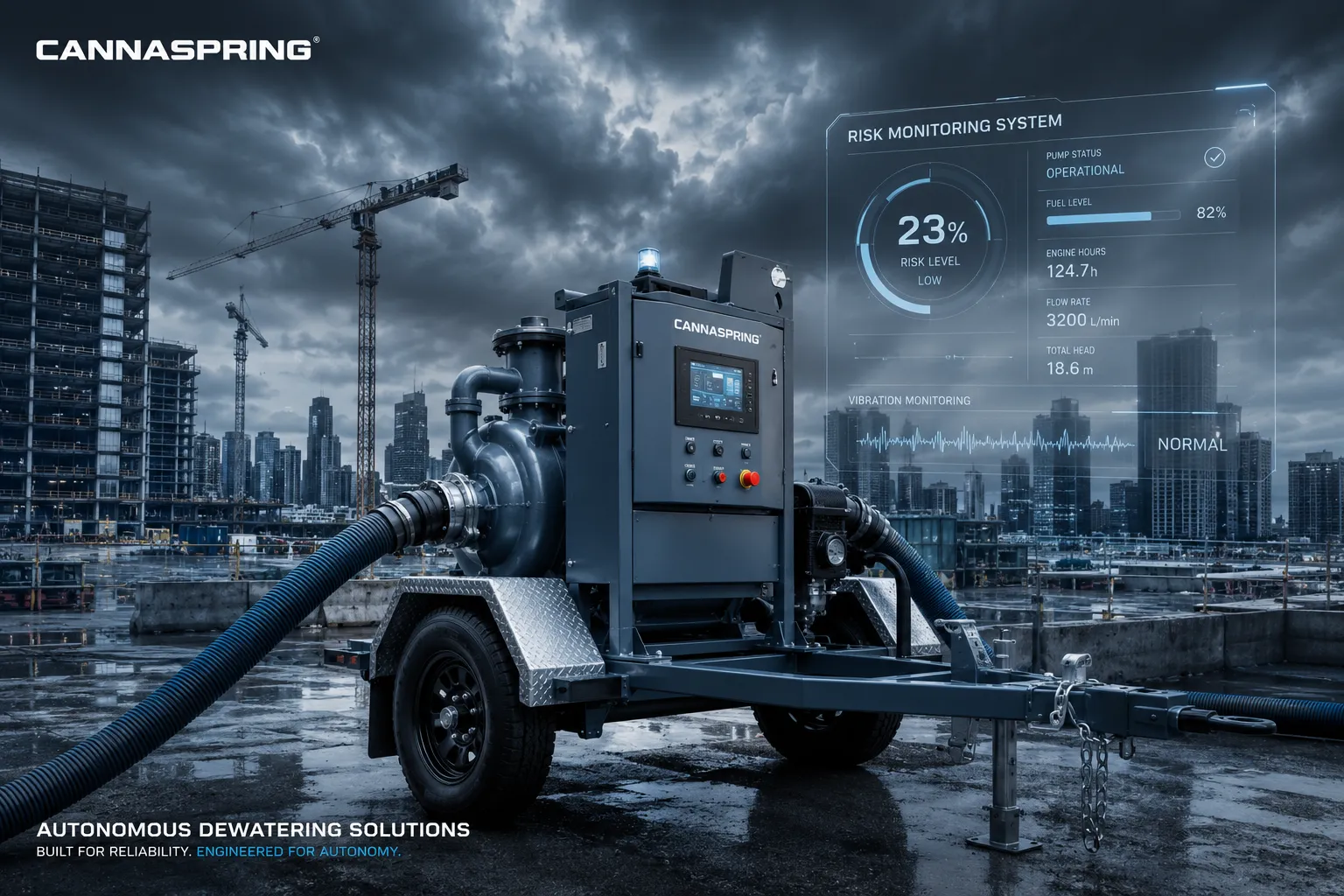
The trailer mounted pump is not just a piece of equipment. It is a mobile defensive position — one that can be repositioned as flood geometry shifts, redeployed to a higher-priority zone as conditions develop, and staged at multiple points simultaneously across a large site. When the storm doesn’t behave as modeled, your defense moves with it.
Redundancy is not excess. It is the plan.
The question isn’t whether to deploy multiple trailer-mounted water pumps. The question is how many your peak inflow calculation requires — and then adding one more. A single-unit architecture is a single point of failure in the highest-consequence scenario your project will face. During active storm conditions, attended maintenance is a personnel safety violation. If your primary unit initiates a protective shutdown and you have no redundant unit pre-staged, you are managing a flooding event with no dewatering capacity at the worst possible moment.
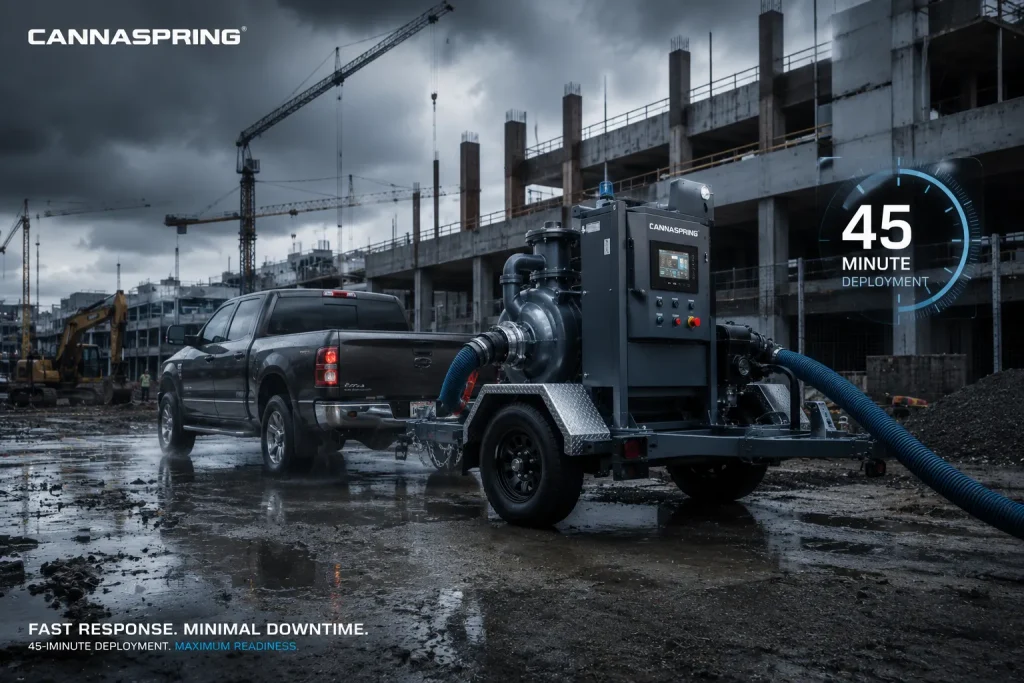
Two units is the minimum for any site above low risk classification. The redundant unit doesn’t sit idle — it is pre-commissioned, pre-staged, and ready to assume full load within 45 minutes of a primary unit shutdown.
Autonomous operation is not a feature. It is a safety requirement.
Keeping personnel on-site to monitor pumps during hurricane-force conditions is not a dewatering strategy. It is a liability. The only operationally and legally defensible approach is equipment that runs, self-monitors, and self-protects without human intervention.
This requires two things working together. First, electronic dry-run protection — a monitoring circuit that tracks pressure and temperature in real time, initiating a controlled shutdown before cavitation damage occurs when suction conditions deteriorate at end-of-drawdown. Second, impeller metallurgy that doesn’t degrade under 72 hours of continuous abrasive load.
On the second point: the management case for high-chrome white iron impellers is not a materials science argument. It’s a budget argument. Gray cast iron impellers wear under sediment-laden floodwater. Flow rate drops. Head pressure drops. By hour 60 of a sustained dewatering campaign, a pump specified at 1,500 GPM may be delivering 900 GPM — exactly when full drawdown capacity is needed most. The maintenance request, the mid-event equipment swap, the schedule delay that follows — those costs exceed the specification premium within a single storm season. High-chrome white iron eliminates that failure mode.
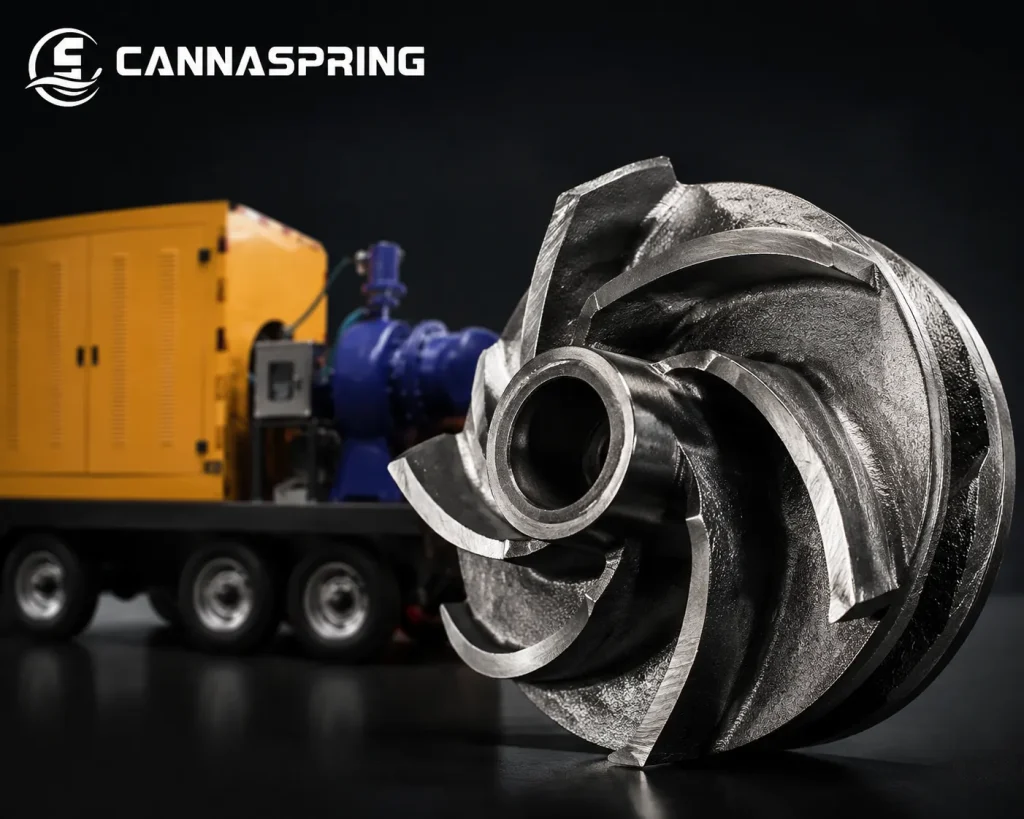
Fewer repair requisitions. Predictable performance through the full campaign duration. That’s the TCO argument, and it belongs in your pre-bid budget, not your post-storm expense report.

Phase 3: Compliance Is Not an Afterthought. It Is a Site Entry Condition.
Here is a scenario that project managers encounter more often than they expect: storm event is over, dewatering is critical, and the equipment is turned away at the site gate. Not because of performance. Because of paperwork.
SPCC compliance under 40 CFR Part 112 — secondary containment for 110% of primary fuel and lubricant volume — is a condition of equipment access on regulated project sites. It is not something resolved at delivery. It is a planning-phase specification requirement.
Equipment that requires supplemental earthwork or temporary containment berms to meet SPCC adds hours to a deployment timeline that may have 45 minutes available. The correct approach is specifying SPCC-compliant equipment at the planning stage — before vendor selection — so that compliance is a base-platform feature, always documentable, never dependent on setup that may not be completed before conditions deteriorate. CANNASPRING’s double-walled containment chassis is engineered for this reason: the compliance condition is permanent, not situational.
The penalty structure for non-compliance does not suspend for weather events. $25,000 per day per violation, with escalation when harm to a navigable waterway is demonstrated. In the post-storm enforcement environment, that exposure is active — and non-compliant equipment faces site ejection at the moment it is most operationally critical.
Tier 4 Final engine compliance follows the same logic. Construction sites in non-attainment air quality zones — a designation that covers significant portions of the Atlantic and Gulf Coast corridor — are subject to emissions enforcement that does not pause during recovery operations. Specifying Tier 4 Final engine platforms at the planning stage eliminates this exposure before it exists. Discovering a Tier 4 compliance gap when an inspector arrives during post-storm operations is not a paperwork problem. It is a shutdown order.
Verify both requirements before vendor selection. Document both before the season opens. Neither should be a discovery.
Phase 4: Stop Deciding. Start Triggering.
The most expensive decisions in a storm event are the ones made under pressure, in real time, with incomplete information. The planning process exists to eliminate those decisions — to replace real-time judgment with pre-committed, trigger-based action.
Define your thresholds now, in writing, before the season opens:
72 hours out: Named storm projected to affect the project area. Confirm equipment status. Verify fuel. Pre-position discharge piping. Notify subcontractors.
48 hours out: Terminal advisory issued. Deploy pumps to primary staging positions. Complete discharge routing. Activate autonomous operation parameters. Clear personnel from flood-risk zones.
24 hours out: Safe access window is closing. All units operating autonomously. Dry-run protection active. No further attended intervention until conditions permit re-entry.
The dry-run protection system is what makes the 24-hour threshold executable. Without it, leaving pumps running unattended through a storm event is operationally irresponsible — the risk of cavitation damage during unmonitored operation is too high. With it, the threshold is a commitment, not a gamble. Equipment runs. Equipment self-protects. Personnel are not in the field.
This trigger framework belongs in your Pre-Season Dewatering Plan as a documented protocol — not a mental model. Any qualified superintendent should be able to execute it without improvisation.
The Shift That Changes Your Risk Profile
Buying a pump is a transaction. Building a dewatering strategy is an engineering engagement — one that starts at the pre-bid phase and produces a documented, executable plan before the season opens.
The difference between those two approaches shows up in one place: the boardroom review after a storm event. One project manager is explaining what failed and why. The other is explaining how the site was back on schedule in 72 hours.
Don’t wait until the hurricane corridor becomes a liability. Contact the CANNASPRING engineering team during your project’s pre-bid phase to build a dewatering strategy that ensures your project holds — no matter the weather.
Part of the CANNASPRING Hurricane Dewatering Series:
To learn how to implement the exact deployment protocols and equipment standards discussed here, continue to our technical breakdown in the CANNASPRING Hurricane Dewatering Series:
- [Hurricane-Ready Trailer Pumps: Industrial Dewatering Systems] — The 45-minute deployment framework (engineered for the 2-hour pre-hurricane safety window), SPCC compliance, and equipment specifications
- [Hurricane Pump: Accelerating Post-Hurricane Recovery through Strategic Site Drainage Optimization] The post-storm tactical guide—mastering the trunk-line drainage matrix and solids-handling protocols required to hit your reopening target.