Hurricane Pump: Accelerating Post-Hurricane Recovery through Strategic Site Drainage Optimization
Every post-hurricane construction recovery site tells the same lie at first glance: it looks like a water problem. It isn’t. Once the standing water recedes even a few inches, the real obstacle surfaces — a compacted layer of sediment, silt, and construction debris sitting on top of every excavation, sump, and roadbed. Water can be pumped out in hours. Sludge is what actually stalls a recovery schedule for weeks, because it clogs the very equipment brought in to remove it.
This is the distinction that separates a functional dewatering plan from a failed one. The objective is not simply “get the water out.” It is industrial flood cleanup in the truest sense: sequential removal of free water, followed by controlled extraction of solids-laden sludge, without destroying pump internals in the process. A trailer mounted pump built for this job is not a bigger version of a stormwater pump — it is a different category of machine, engineered around abrasion, not just flow rate.
Phased Recovery Strategy: Trunk Drainage First, Pit Desludging Second
A common and costly mistake is deploying every available pump simultaneously across a flooded site on day one. This spreads capacity thin, sends light-duty pumps into heavy-sediment zones they were never built for, and produces no measurable progress for the first 48 hours — the exact window when client and insurer pressure is highest.
The more effective approach follows two distinct phases:
Phase 1 — Trunk-line drainage. Before any localized pit or foundation work begins, the priority is establishing a primary drainage corridor: moving bulk standing water off the main site grade toward a legal discharge point or retention area. This phase favors high-volume, moderate-head pumps positioned at the lowest elevation points and at any natural or engineered discharge route. The goal here is speed — dropping the general water table across the site so that access roads, staging areas, and equipment paths become usable again.
Phase 2 — Pit and sump desludging. Only once the trunk system has established a stable, lower water level does work shift to individual excavations, foundation pits, elevator shafts, and utility vaults — the areas where sediment has settled and concentrated. These pockets require a different pump profile entirely: solids-handling capability takes priority over raw throughput, because this is where suspended sand, gravel fines, and organic debris are most concentrated.
Coordinated Multi-Pump Deployment: Building a Drainage Matrix
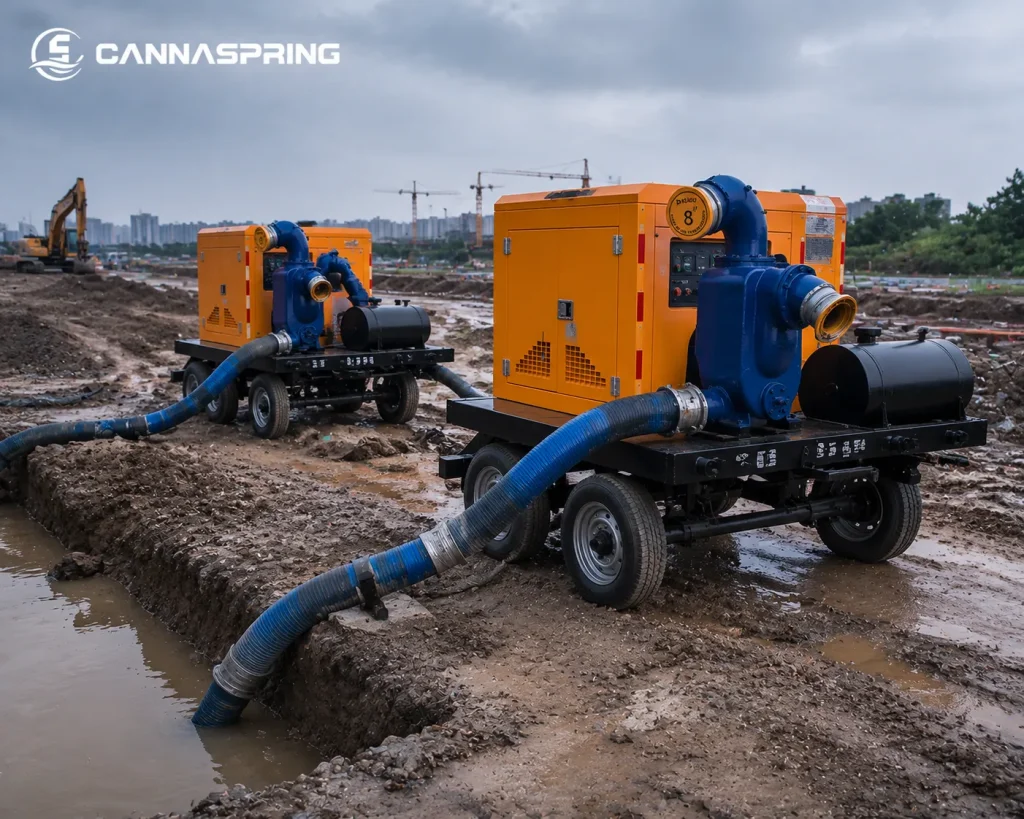
Field deployment of a dual-trailer pump matrix for heavy-duty mobile dewatering. By configuring units in a coordinated layout, contractors can manage high-sediment flows that exceed the capacity of a single-pump setup.
On any site larger than a single pit, a single pump — regardless of size — creates a bottleneck. The practical solution is deploying multiple trailer-mounted units in a coordinated matrix rather than treating each pump as an isolated tool:
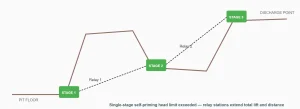
- Series staging (head-boosting): Where the discharge run has to climb significant elevation to reach a legal outfall, a relay pump is staged mid-route to re-pressurize the flow, rather than forcing one unit to fight the entire static head alone. This keeps each pump operating near its efficiency curve instead of straining against a head it wasn’t sized for.
- Parallel staging (volume-boosting): In wide, shallow flood zones, multiple pumps discharge into a shared header line, combining flow to move volume that no single trailer unit could handle economically.
- Zone assignment: Each pump is assigned a defined catchment zone with its own suction point, rather than being repositioned reactively. This keeps hose runs short, reduces friction loss, and lets a site supervisor track drawdown progress zone by zone instead of guessing at overall site conditions.
Because every unit is trailer-mounted with independent power, this matrix can be reconfigured in hours, not days — pumps are unhitched and relocated as each zone clears, rather than waiting on a fixed piping network to be redesigned.
Handling the Sediment Challenge: Why Wear Material Determines Uptime
- High-chromium wear-resistant alloys (typically in the 25–28% Cr range) in the impeller, wear plate, and volute liner provide substantially higher abrasion resistance than standard cast iron or mild steel, because the chromium carbide structure resists the cutting action of suspended sand and grit rather than eroding under it.
- Non-clog / vortex impeller geometry matters as much as the alloy itself. A recessed vortex impeller keeps solids-laden flow largely out of direct contact with the impeller vanes, letting debris pass through the pump casing rather than through tight impeller clearances — critical when the fluid carries broken drywall, wood fragments, and gravel alongside fine silt.
- Replaceable wear plates and liners extend service life between rebuilds by isolating erosion to low-cost, field-replaceable components rather than the impeller or casing itself — a meaningful difference when a pump is expected to run continuously for weeks during a recovery push.
The practical result: a pump built with these features maintains rated flow and head over a multi-week deployment, instead of losing 20–30% of capacity within the first 72 hours as clearances erode. In a recovery timeline measured in days, that difference in sustained performance is the difference between hitting a reopening date and missing it.
Why the Trailer Pump Is the Only Realistic Option
In a normal dewatering scenario, a fixed or submersible installation tied into site power is often the more economical choice. Post-hurricane conditions invert that logic entirely.
Grid power is not available, and its return date is unknown. Utility restoration after a major hurricane routinely lags site-access restoration by days or weeks. Any pump dependent on utility power — or even a generator tied to a fixed installation — is idle exactly when it’s needed most.
Fixed and submersible infrastructure is often the casualty, not the solution. Electrical panels, submersible pump controls, and fixed wet-well equipment are frequently among the first things damaged by the flood itself. Relying on site infrastructure that has just been destroyed to power its own recovery is a structural contradiction.
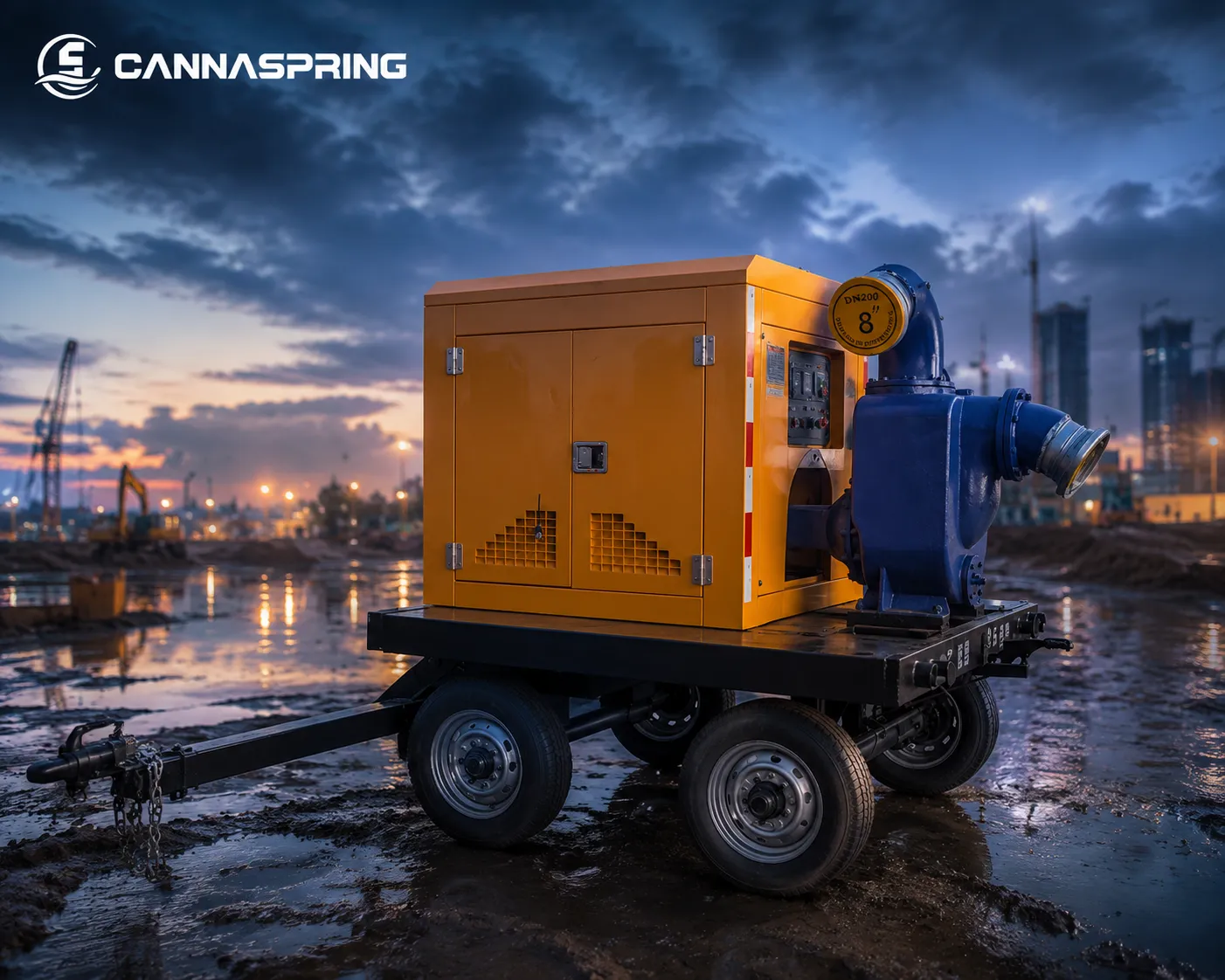
A trailer mounted water pump carries its own power plant. A diesel-driven trailer unit is a self-contained system: engine, pump, fuel tank, and priming system on one chassis. It requires no site power, no control panel installation, and no electrician sign-off before startup. It is towed to the suction point, primed, and running within the hour — genuinely plug-and-play in an environment where nothing else is.
Mobility is the operational advantage, not a convenience. As the phased strategy above shows, recovery work moves across a site — from trunk lines to individual pits to newly discovered pockets of standing water. A trailer platform relocates in the time it takes to hitch and tow, letting the same unit serve trunk drainage on day one and pit desludging on day four, redeployed wherever drawdown data shows it’s needed next.
Fuel autonomy sustains 24-hour operation. With on-board fuel capacity and extended run-time tanks, trailer units sustain continuous operation across shift changes without dependency on a fragile, still-recovering power grid — a requirement when every day of downtime compounds project delays and cost overruns.
The Bottom Line
Post-hurricane site recovery is won or lost on two variables: how fast trunk water volume drops, and whether the equipment doing that work survives contact with sediment long enough to finish the job. A phased trunk-then-pit strategy, deployed through a coordinated multi-pump matrix, addresses the sequencing problem. High-chromium wear components and non-clog impeller design address the sediment problem. And independent, engine-driven trailer mobility addresses the power problem that defines every disaster-recovery site before the grid comes back.
Together, these are the three variables that separate a site that reopens on schedule from one still fighting standing water a month later.
The Hurricane Resilience Series
[Hurricane Readiness: Why Your Choice of Trailer Pump is a Strategic Decision]
Strategic asset protection through SPCC compliance, remote monitoring, and advanced material engineering.
[Hurricane-Ready Trailer Pumps: Industrial Dewatering Systems]
Engineering for long-term reliability, EPA compliance, and optimized total cost of ownership.