Why Submersible Pumps Fail in Stormwater Events (And Why Contractors Switch to Trailer-Mounted Pumps)
The Night the Water Kept Rising
It’s 2 a.m. The rain hasn’t stopped in six hours. Your site supervisor calls — the excavation pit on Block C has water rising past the 1.2-meter mark, and both submersible pumps just tripped offline. The crew is standing at the edge of the pit, flashlights in hand, looking down at two thousand dollars of equipment that’s now sitting silent under half a meter of turbid runoff. The nearest electrical distribution panel is flooded. The generators are on the other side of the site.
By morning, three days of concrete formwork will be compromised.
This isn’t a scenario that needs dramatizing. Ask any site foreman who’s run drainage on an urban construction job during a heavy monsoon or nor’easter — this is a known failure mode, and it happens often enough that it should have been planned for.
The question isn’t why the pumps failed. The question is why contractors keep relying on equipment that has three structural weaknesses that make it predictably unreliable in the exact conditions where reliable drainage matters most.
—
Three Structural Weaknesses of Submersible Pumps in Stormwater Events
⚠️ These are the three failure points that repeatedly cause project delays in real-world stormwater conditions:
—
🔥 1. They Require Water to Be Present Before They Can Work
This sounds obvious, but the operational implication is frequently underestimated.
A submersible pump must be submerged to function — the motor depends on surrounding water for cooling, and the impeller needs to be primed by the water column above it. In practice, this means the pump does nothing during the critical early phase of an inflow event, when water is still accumulating. By the time the water level is high enough to cover the pump body and trigger effective suction, the lower portions of your excavation, slab, or basement entry are already compromised.
This is not a flaw in the design — it’s an inherent constraint of the submersible architecture. These pumps were designed for sustained, steady-state dewatering in contained excavations, not for rapid-response emergency drainage. They have no vacuum-assist mechanism. They cannot pull water toward them; they can only expel water that has already surrounded them.
A vacuum-assisted pump operates on an entirely different principle: the vacuum system evacuates air from the suction line, creating differential pressure that draws water up and into the pump body before the pump is ever submerged. Deployment begins immediately upon positioning. There is no accumulation threshold.
—
🔥 2. They Run on Grid Power — Which Fails Exactly When You Need Them Most
Severe stormwater events and power outages are not independent variables. They’re correlated. Flooding, lightning strikes, and utility load-shedding during storm peaks all degrade or eliminate grid power at the same time that drainage demand is highest.
A submersible pump without power is not a backup. It’s a weight.
Beyond outright power loss, the electrical environment during stormwater events creates its own problems. Extension runs across a flooded site introduce ground fault risk. Temporary power panels sitting in standing water trip breakers. Generator fuel gets consumed by lighting and other site loads before drainage is prioritized.
Diesel-driven mobile dewatering pumps operate completely outside this dependency chain. The engine runs as long as there’s fuel in the tank — which, on a properly maintained trailer pump, means 10 to 12 hours of continuous operation per fill. When the grid goes down at 11 p.m. and your crew is deciding what equipment to trust through the night, independent power is not a premium feature. It’s the minimum acceptable specification for emergency drainage.
—
🔥 3. Failure Recovery Requires Someone to Go Into the Water
When a submersible pump trips on thermal overload — which it will, because stormwater carries fine sediment that progressively occludes the intake screen and starves the cooling jacket — the recovery process requires retrieving it from the bottom of a flooded pit.
That means someone suited up, going into water of unknown depth and turbidity, disconnecting a live electrical device (or confirming it’s been isolated), and hauling the unit out for cleaning or replacement. In a 600mm rainstorm event, the bottom of that pit may have 0.5 meters of silt-laden runoff moving at speed. This is not an efficiency problem. It’s a site safety issue.
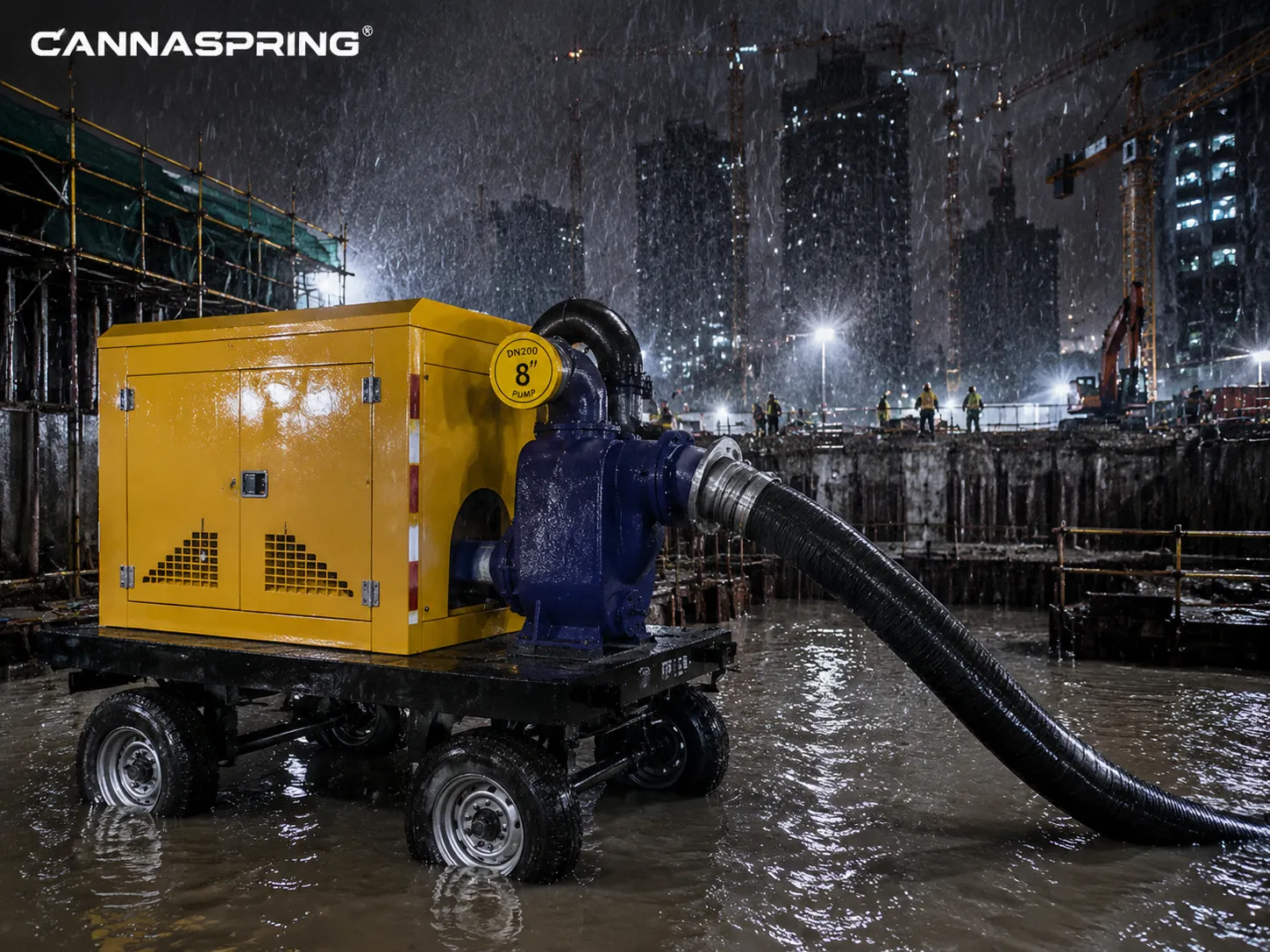
A trailer-mounted pump unit keeps the mechanical components above the waterline. The suction hose goes into the water; the pump, motor, and controls stay on the trailer deck. If the intake screens need clearing, that’s a task performed at standing height, on dry ground, in under five minutes. Mean time to restore operation is measured in minutes, not hours.
—
What Contractors Are Actually Deploying Instead
The trailer-mounted pump configuration has been around for decades in municipal flood response, but its adoption in private construction and civil contracting has accelerated significantly in the last five years — driven less by innovation than by accumulated project losses from submersible pump failures during storm events.
The core architecture of a trailer pump unit for emergency drainage typically includes:
Diesel prime mover — Independent of grid infrastructure. Tier 4 Final engines on modern units run quietly enough for urban sites and meet most local emissions ordinances for overnight operation.
Vacuum-assist priming system — A small dedicated vacuum pump evacuates the suction line in 60 to 90 seconds, drawing water from the source without manual priming or foot valves. On a 6-inch unit positioned at grade, this means you can begin moving water before the first crew member has finished unrolling suction hose.
Trailer mobility — A trailer pump can be repositioned between dewatering points in the time it takes to disconnect a suction hose. On a multi-block urban project with several active excavations, a single trailer pump unit covering multiple points is often more cost-effective — and more operationally flexible — than installing fixed submersible units at each location.
—
The Risk Calculation Contractors Are Actually Making
A submersible pump in the 4- to 6-inch range costs somewhere between $800 and $3,000 per unit, depending on specification. That’s the number that usually ends the equipment conversation.
Here’s the number that should be driving it instead: what does a 48-hour project delay cost on a mid-scale civil or foundation contract?
On a project with $50,000 per week in labor, equipment, and subcontractor commitments, a two-day stoppage from preventable flooding costs roughly $14,000 in direct carry. Add concrete cure schedule disruption, potential rework on compromised formwork, and owner-imposed liquidated damages clauses on time-sensitive projects, and the number climbs fast.
The rental rate for a trailer-mounted pump with vacuum assist for a week of stormwater coverage is typically $1,500 to $4,000 depending on size and market. Purchase prices for a capable unit start around $25,000 to $40,000.
This isn’t a cost-versus-cost comparison anymore. It’s a risk-versus-certainty comparison. The submersible pump offers low upfront cost and uncertain performance in extreme conditions. The trailer pump offers predictable, grid-independent, rapid-deploy drainage capability — which, in a stormwater emergency, is what you’re actually buying.
—
Choosing the Right Tool for the Conditions
Submersible pumps are appropriate equipment for many applications: sustained dewatering in stable excavations, sump maintenance in enclosed structures, water transfer in controlled environments. They’re reliable, low-maintenance, and cost-effective when the conditions match their design envelope.
They are not designed for high-volume, rapid-response emergency drainage under grid-uncertain conditions. That’s not a criticism — it’s a specification boundary.
When your exposure includes hard construction schedules, below-grade work in urban flood zones, or projects that can’t tolerate a 12-hour drainage gap, a diesel-driven trailer pump with vacuum-assist priming is the appropriate risk management response. It is, in the most practical sense, a project insurance policy — one that pays out on exactly the nights when everything else is failing.
—
CANNASPRING designs and manufactures mobile trailer-mounted pump systems for emergency drainage and stormwater pumping applications. If you’re evaluating dewatering strategy for an upcoming project, contact our team for application-specific configuration recommendations.
Learn More About Pump Mechanics
For a deeper dive into the pump engineering principles that make vacuum-assist superior, or to see our guide on calculating the right flow rate for your specific site conditions, visit our technical blog at: What is a Vacuum-Assisted Pump? How Does a Vacuum-Assisted Pump Work?