What is a Vacuum-Assisted Pump? How Does a Vacuum-Assisted Pump Work?
The Priming Problem Nobody Talks About
In the previous post, we covered why submersible pumps fail during stormwater events — but one failure mode deserves a closer look, because it’s the most operationally damaging and the least discussed.
Submersible pumps require the water to come to them. The unit sits at the bottom of an excavation or sump, and drainage only begins once the water level has risen high enough to submerge the motor and intake. In a slow, steady groundwater seep, that’s fine. In a stormwater inflow event — where you’re taking on 80 to 150mm of rain in four hours — that delay is the difference between a manageable situation and a flooded pour.
This is the priming problem: traditional pump architectures can’t begin moving water until water has already moved to them.
Vacuum-assisted pumps were designed specifically to eliminate this constraint.
—
What a Vacuum-Assisted Pump Actually Does (Without the Physics Lecture)
Think of a conventional centrifugal pump — submersible or surface-mounted — as a swimmer who needs to be in the pool before they can start their lap. If the pool isn’t filled yet, they wait.
A vacuum-assisted pump is different. It’s the equivalent of a crew with industrial suction equipment: before anyone touches the water, they’ve already evacuated the pipe of air, created a low-pressure zone, and let atmospheric pressure do the work of pushing water up the suction line. By the time you’d still be waiting for a conventional unit to prime, water is already moving.
Here’s the mechanism in plain terms:
The system includes a dedicated vacuum pump — a small, separate component that runs ahead of the main pump. Its only job is to pull air out of the suction line. As it does, it creates a partial vacuum inside the hose. Atmospheric pressure at the water source — whether that’s a flooded excavation, a sump, or a roadside drain — pushes water up the line to fill the void.
Once water reaches the main pump impeller, the vacuum pump steps back and the primary pump takes over. Total time from suction hose in water to full pumping operation: typically 45 to 90 seconds, depending on suction lift and hose length.
This is what the industry calls an auto-priming system. The operator drops the hose, starts the engine, and the pump handles the rest. There’s no manual filling, no foot valve dependency, no waiting for water to accumulate to a threshold level.
—
Why Contractors Prioritize This Capability
Instant Response When It Counts
Stormwater drainage isn’t a planned maintenance task. It’s a reaction to conditions that escalate in real time. The value of a vacuum-assisted pump isn’t just convenience — it’s the ability to deploy a mobile dewatering pump and begin moving water within two minutes of arriving on site.
On a job where a ground-floor concrete slab is at risk from rising water, or where a utility trench is filling faster than anticipated, that two-minute deployment window matters. The alternative — positioning a submersible unit, waiting for water to accumulate, hoping the grid holds and the intake doesn’t clog — involves multiple variables that can each add 30 to 90 minutes of delay in adverse conditions.
When contractors describe why they’ve moved toward Trailer-mounted pump systems for their critical-path dewatering work, rapid suction consistently ranks as the primary operational factor. Not because the technology is impressive, but because project schedules don’t accommodate slow starts.
—
🔥 Dry-Running Capability: The One That Changes the Cost Equation
This is worth dwelling on, because it’s the feature that generates the most surprise when contractors encounter it for the first time.
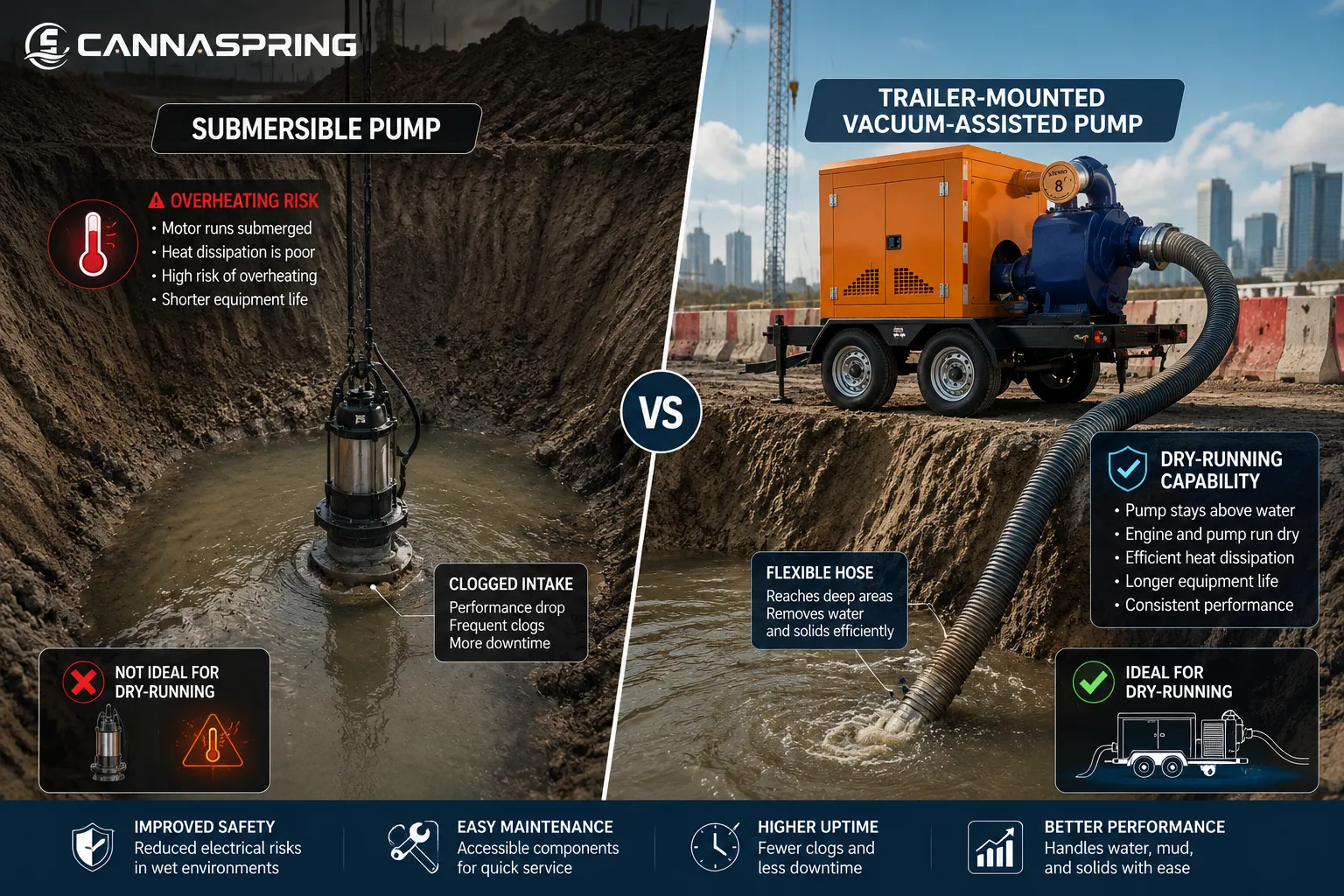
Submersible pumps are water-cooled. The motor relies on surrounding fluid to dissipate heat. When water levels drop below the motor casing — because you’ve successfully dewatered the area, or because inflow has slowed — the pump runs dry, overheats, and trips on thermal protection. In a sustained stormwater event with variable inflow rates, this can happen multiple times per night. Each trip is a restart, a delay, and a reduction in the motor’s service life.
Vacuum-assisted pumps with Dry-running capability are designed for air-cooled or mechanical-seal configurations and are built to continue operating safely when water levels fluctuate.
For a contractor running a mobile dewatering pump across a site with multiple low-lying collection points, this distinction is significant. You’re not stopping to check whether the unit has tripped, not resetting thermal overloads in the dark, not worrying that a submersible unit at the bottom of a pit has run dry and burned out while you were managing another area. The pump runs. You work.
—
🔥 Solids Handling in Real Site Conditions
Construction site stormwater is not clean water. It’s a suspension of fine silt, clay, aggregate fines, and occasionally larger material — gravel, sand, clumps — that accumulates in excavations over time.
Submersible pumps clog quickly under these conditions due to intake restrictions and fine sediment buildup.
Vacuum-assisted pumps are designed for improved solids handling, allowing higher tolerance to debris without immediate fouling.
—
🔥 Mobility Closes the Argument
A submersible pump is deployed at a fixed point. If conditions shift, you need multiple units across multiple locations.
A Trailer-mounted pump can be repositioned between dewatering points in the time it takes to move hose connections.
—
What You’re Actually Buying
A vacuum-assisted trailer pump is not sophisticated technology. The engineering principles are mature, the components are serviceable in the field, and the operational requirements are minimal.
What you’re buying is certainty.
Rapid auto-priming, Dry-running capability, solids handling, independent power, and mobility are not premium features — they are baseline requirements for emergency drainage systems.
—
CANNASPRING specializes in trailer-mounted pump systems engineered for rapid deployment in emergency drainage and stormwater pumping applications.
👉 View our product specification sheets
Go Deeper: Risk Management in Dewatering
Understanding the advantages of vacuum-assisted systems is only half the battle. To see why traditional submersible pumps so often fail during peak stormwater events—and the exact financial cost of these failures on construction schedules—read our full breakdown here: [Link: Why Submersible Pumps Fail in Stormwater Events].