Underground vs Open-Pit Mining Dewatering Pumps
The same trailer-mounted pump that rolls straight up to the rim of an open pit and starts dewatering within the hour may not be able to reach the water at all in an underground mine — not because of a flow or head shortfall, but because the physical environment underground rules out the equipment before performance ever becomes the question. This works through where an open-pit mining pump and an underground mining pump genuinely need to differ, and where the difference actually comes from: access, ventilation, safety certification, power availability, relay topology, and inflow risk.
On This Page
Access and Mobility: Trailer Deployment vs Confined-Space Constraints
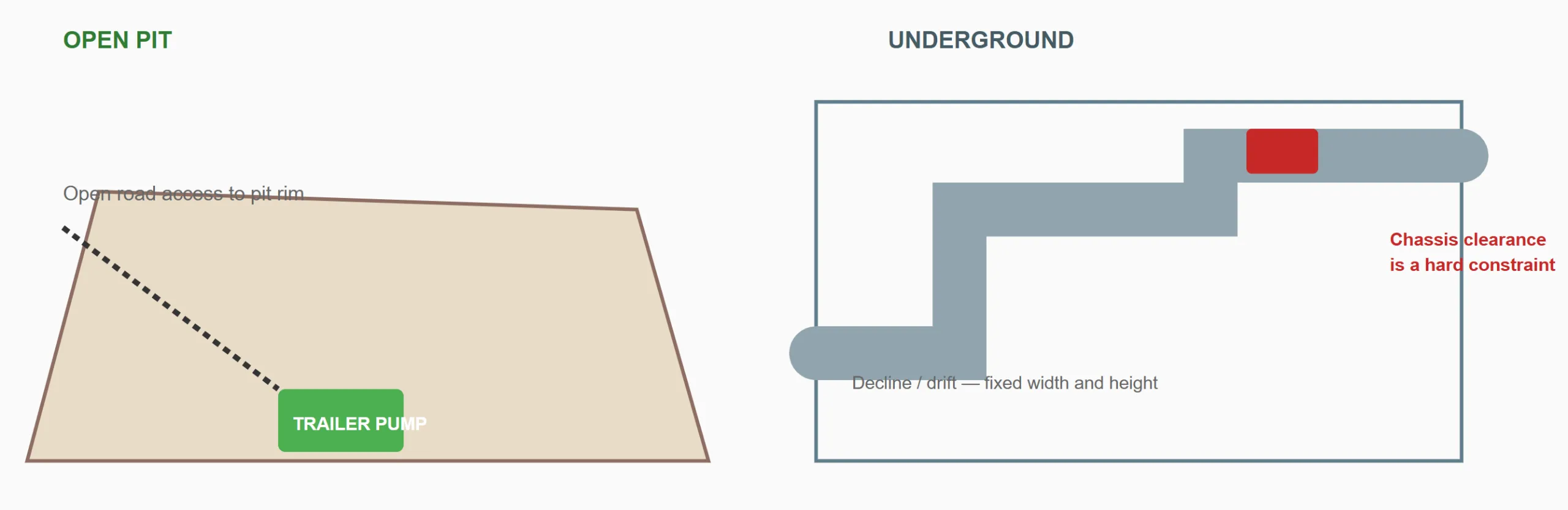
In an open pit, a trailer-mounted mining pump is towed directly to the pit rim or down a haul road to the sump itself — the same road vehicles and equipment already use to move through the site. Underground, that same access question depends entirely on the mine’s specific decline, shaft, or drift dimensions: a trailer chassis sized for surface roads may simply not clear the width, height, or turning radius of an underground haulage way, and even where it physically fits, maneuvering and positioning it in a confined drift is a different task than backing it up to an open sump on level ground. This is why underground mining pump selection starts with the specific access route’s dimensions as a hard constraint, not a convenience factor — a unit that performs perfectly on paper is irrelevant if it can’t reach the water.
Ventilation and Exhaust: Why Diesel Behaves Differently Underground
An open-pit diesel mining pump exhausts into open air, where natural dispersion handles the exhaust volume without further engineering. Underground, that same exhaust output enters a confined, ventilated space shared with personnel and other diesel equipment, where it has to be actively diluted and carried out by the mine’s ventilation circuit rather than dispersing on its own. This means an underground diesel pump’s exhaust output has to be evaluated against the specific ventilation air quantity available at that point in the mine — a variable that changes by location and by how much other diesel equipment is already operating in the same ventilation zone — rather than being a non-issue the way it is at the surface. In ventilation-constrained sections of a mine, this is frequently the deciding factor that pushes underground dewatering toward electric-driven equipment instead of diesel, independent of anything related to the pump’s hydraulic performance.
Permissible and Intrinsically Safe Equipment Requirements
An open-pit mining pump operates in open atmosphere, with no explosive gas accumulation risk to design around. Underground — specifically in gassy mines where methane or other flammable gas can accumulate, most commonly associated with certain coal operations — equipment operating in those zones is typically required to meet permissible or intrinsically safe certification standards, meaning it’s been specifically designed and tested to not provide an ignition source even in the presence of accumulated gas. This is a genuine equipment certification category, not a general “heavy-duty” rating, and standard diesel or electric equipment built for open-pit or general industrial duty does not automatically qualify. Whether this requirement applies at all depends entirely on the specific underground operation and its gas classification — it’s a mine-specific compliance question to confirm before specifying equipment, not a universal underground requirement.
Power Availability: Established Underground Circuits vs Remote Open-Pit Gaps
Open-pit dewatering points are often exactly where grid power is least likely to reach — a sump at the bottom of an active pit, or a temporary drainage point following the working face, sits well outside any established electrical infrastructure, which is a core reason diesel-driven open-pit mining pumps remain the default. Underground, the situation frequently reverses: established mine workings commonly already have electrical distribution run to working levels for lighting, ventilation fans, and fixed equipment, putting grid power within practical reach of many underground dewatering points in a way it rarely is for a moving open-pit sump. This difference in power availability, independent of the ventilation and gas-classification factors already covered, is a second reason electric-driven pumps are more common underground than the diesel-dominant pattern typical of open-pit dewatering.
Relay Staging Topology: Vertical vs Level-by-Level
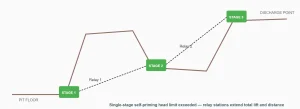
Where a single pump’s head capability falls short, both environments use relay staging — but the physical arrangement differs entirely. An open-pit relay chain runs vertically up the pit wall, with each stage lifting water a further increment toward the surface discharge point along a single, mostly continuous route. An underground relay chain instead runs level by level: water collecting at a lower working level gets pumped up to a sump or collection point on the level above, which in turn gets pumped up to the next level, following the mine’s actual level structure rather than a single continuous vertical run. This level-by-level topology means underground relay planning has to account for each level’s own sump capacity and pump siting independently, rather than treating the whole lift as one continuous open-pit-style relay chain.
Sudden Inflow Risk: Different Water Ingress Patterns
Open-pit water ingress is generally a gradual, visible process — seepage across exposed pit walls and benches that a hydrogeological forecast tracks reasonably well over the mine’s operating life, discussed in more detail in our mine dewatering sizing guide. Underground workings carry a different and more acute risk: breaking into a water-bearing fracture zone or old, flooded workings can produce a sudden, high-volume inflow at the working face itself, with far less warning than the gradual pattern typical of open-pit seepage. This risk profile is why underground dewatering planning often builds in more standby and emergency-response capacity relative to steady-state flow than open-pit planning typically requires — the design question underground isn’t just “what’s the steady inflow,” but “what happens if a sudden breakthrough occurs at this specific working face.”
Where Trailer-Mounted Diesel Pumps Fit Today
Being direct about scope here matters more than force-fitting one product line across both environments. Our ZBCY-series trailer mounted water pump (up to 3,000 m³/h flow, 120m head, 75mm/3-inch solids handling) and our SCPY-series Self-Priming Diesel Trash Pump – Trailer Mounted Pump (80–600 m³/h, 7.5–31m head, 76mm/3-inch solids, self-priming to 7.6m suction lift without vacuum assist) are trailer-mounted, diesel-driven surface equipment — a strong fit for open-pit dewatering at every stage covered above, and equally suited to underground sites with adequate portal or decline access, ventilation capacity, and no gassy-mine permissible equipment requirement. For confined-space underground drifts that a trailer chassis can’t access, or gassy underground workings requiring permissible/intrinsically safe certification, that’s a site-specific configuration question worth working through directly with our engineering team rather than assuming a standard surface unit applies.
Open Pit — Good Fit Today
Pit rim and bench access via haul roads, standard atmosphere, remote sites without grid power, vertical relay staging up the pit wall.
Underground — Confirm First
Portal/decline dimensions vs. trailer chassis size, ventilation capacity for diesel exhaust, gas classification and permissible equipment requirements, level-by-level relay planning.
Frequently Asked Questions
Q: Can a trailer-mounted diesel mining pump be used underground at all?
A: Yes, where the decline or drift dimensions accommodate the trailer chassis, ventilation capacity can handle the diesel exhaust load, and the working area isn’t subject to gassy-mine permissible equipment requirements. Each of these needs to be confirmed for the specific underground site rather than assumed.
Q: Why is electric power more common for underground dewatering than for open-pit dewatering?
A: Two independent reasons converge underground: established underground workings often already have electrical distribution run to working levels, and diesel exhaust in a confined, ventilated space is a bigger engineering concern than it is at the open-pit surface — both push toward electric-driven equipment underground more often than open-pit conditions do.
Q: Does relay staging work the same way underground as it does in an open pit?
A: No — open-pit relay follows one continuous route up the pit wall, while underground relay follows the mine’s discrete level structure, with each level’s water sumped and lifted to the level above independently rather than treated as one continuous vertical chain.
Q: Does every underground mine require permissible or intrinsically safe equipment?
A: No — this requirement is specific to gassy mines where flammable gas accumulation is a recognized risk, most commonly associated with certain coal operations. Whether it applies depends on the specific mine’s gas classification, not underground operation in general.
To confirm whether your underground access, ventilation, and safety classification suit a standard trailer-mounted configuration — or to scope a custom setup where they don’t — explore our mining dewatering pump solutions or contact the CANNASPRING engineering team directly.