Trailer Dewatering Systems for Construction & Mining | Pump Solutions Guide
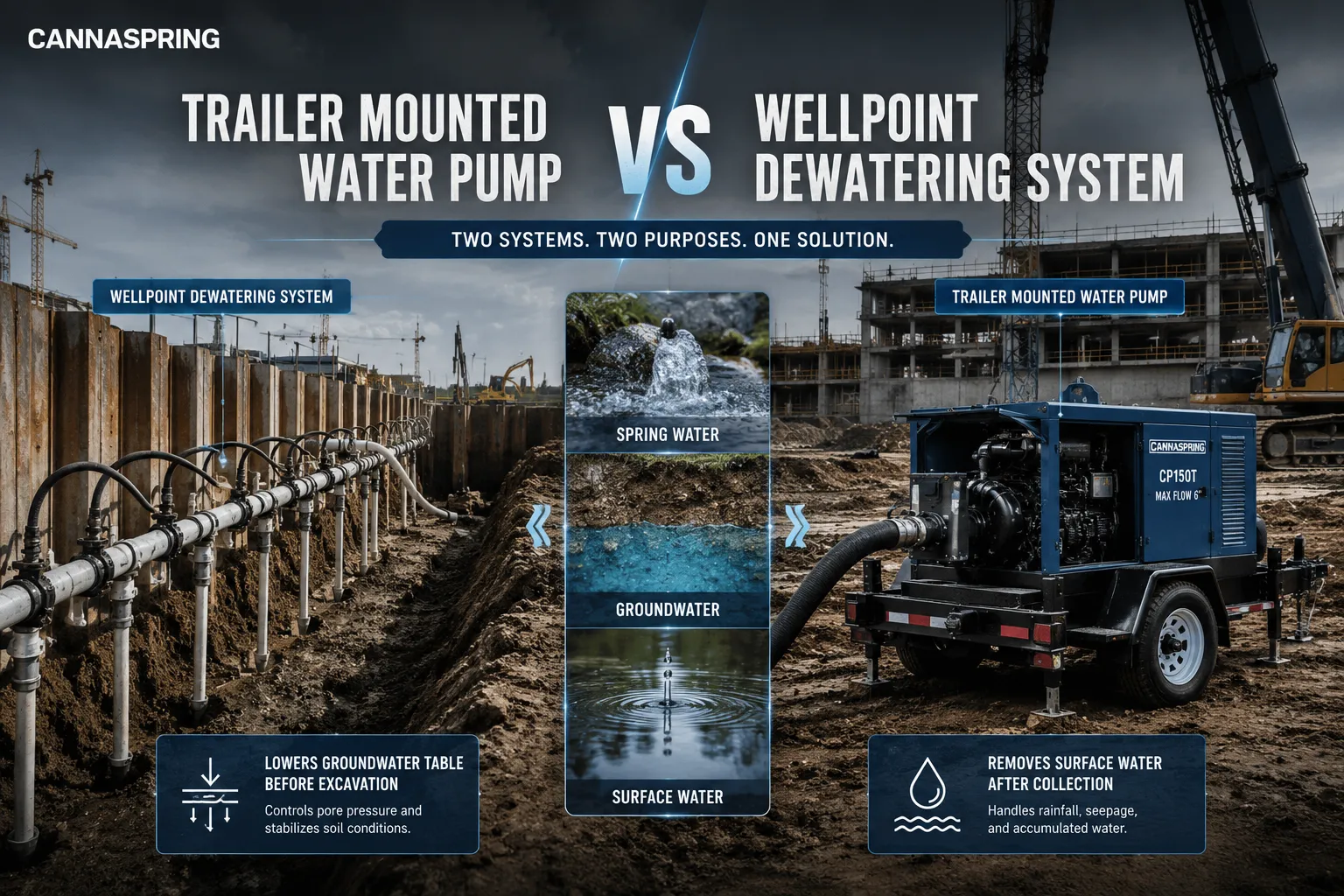
This article compares trailer mounted water pumps and wellpoint dewatering systems, two commonly used solutions in construction dewatering. While both deal with water removal, they serve fundamentally different engineering purposes and operate at different levels of the groundwater system.
Core Technical Difference: Surface Water vs Groundwater Control
The key difference between these systems is how they interact with water in the ground.
A wellpoint system controls groundwater within the soil mass. By lowering the water table, it reduces pore pressure and prevents issues such as slope failure, base heave, and soil piping in fine sands and silts.
A surface dewatering pump handles surface water only. It removes accumulated water from sumps, rainfall, or visible seepage but does not influence soil pore pressure or groundwater behavior.
Using sump pumping alone in high groundwater conditions can lead to instability risks, even if surface water appears controlled.
When Wellpoint Dewatering Is the Right Choice
- Fine sand, silty sand, or silt with a high water table
- Risk of slope instability or base heave
- Excavation requires pre-lowering of groundwater
- Soil conditions indicate piping or boiling risk
Wellpoint systems are essential when groundwater conditions directly affect excavation safety and soil stability.
When Surface Dewatering Is the Right Choice
- Surface water accumulation (rainfall, runoff, sump water)
- Low or stable groundwater conditions
- Short-term or rapidly changing site requirements
- Water containing debris or requiring trash/sewage handling capability
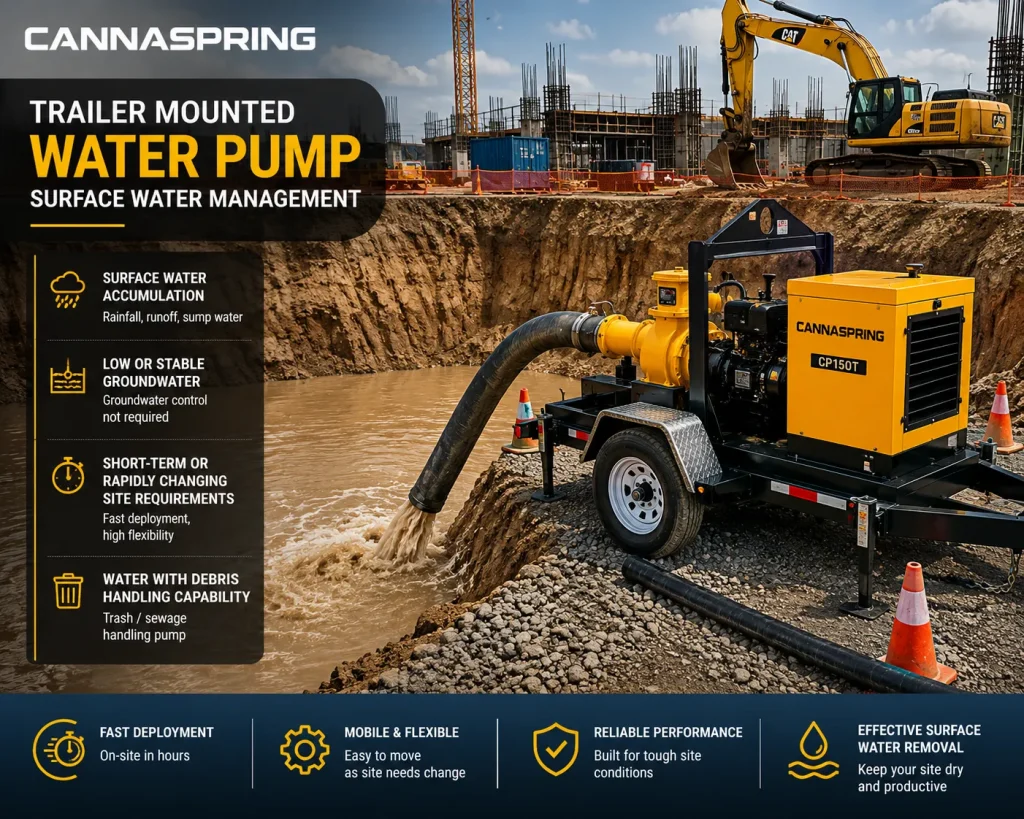
Mobile surface pumping is best suited for flexible, fast-response dewatering where groundwater control is not required.
ZBCY Series
The ZBCY Series is designed for mobile dewatering applications where rapid deployment, high pumping capacity, and reliable solids handling are required.
- Flow rate: up to 3,000 m³/h
- Head: up to 120 m
- Solids handling: up to 75 mm (3 in)
- Diesel-driven
- Self-priming
- Trailer-mounted
Learn more about the ZBCY Series
Why Many Projects Require Both Systems
In many deep excavation projects, both systems are used together. A wellpoint system manages groundwater and stabilizes soil conditions, while mobile surface pumps handle residual water inside the excavation.
This combined approach ensures both groundwater control and site-level water management are addressed simultaneously.
Cost and Mobilization Comparison
These systems differ significantly in installation time, labor requirements, and operational complexity.
Installation Timeline
Wellpoint systems require installation, connection, and drawdown testing before excavation. Mobile surface pumps can be deployed within hours.
Labor and Equipment
Wellpoints require specialized installation crews and monitoring systems. Surface pumping equipment requires minimal operational labor after setup.
Site Footprint
Wellpoint systems occupy the full excavation perimeter. Mobile surface pumps have a small, mobile footprint.
Cost Consideration
Wellpoint systems have higher upfront cost but solve groundwater issues that surface pumping cannot address. Surface pumps are more economical for surface water handling only.
Choosing the Right Setup for Your Site
The decision should always be based on geotechnical conditions rather than equipment preference.
If the site has a high groundwater table in fine-grained soils, a wellpoint system or hybrid solution is recommended. If the issue is mainly surface water or rainfall, a ZBCY Series is often sufficient.
Correct pump sizing, including flow rate and solids handling capability, is critical to avoid downtime and inefficiency on site.
FQA
Can a trailer mounted water pump replace a wellpoint system entirely?
Not in soil conditions where groundwater stability is the actual concern. A surface dewatering pump removes water that has already reached the surface, but it doesn’t lower the water table or relieve pore water pressure in the surrounding soil. If the geotechnical report shows a shallow water table in fine sand or silt with a real risk of piping, boils, or slope instability, a wellpoint system is doing a job a surface pump simply can’t.
How long does a wellpoint system take to install compared to a trailer mounted pump?
A wellpoint ring typically takes several days to a week or more to install and reach the target drawdown, since each wellpoint needs to be driven or jetted into place and the system needs a test period before excavation begins. A mobile surface pump, by comparison, can usually be positioned and running within a few hours.
Is it normal to use both a wellpoint system and a trailer mounted pump on the same project?
Yes, and on many deep excavation projects it’s actually the more common setup. The wellpoint system controls the groundwater table and seepage pressure across the site, while a mobile surface pump clears the residual water that collects in sumps — rainfall, minor seepage, or wash-down water. They’re solving different parts of the same problem, not competing for the same job.
What happens if I use only a trailer mounted pump on a site that actually needs a wellpoint system?
The visible water gets managed, but the underlying pore pressure problem in the soil doesn’t go away. That can mean continued seepage into the excavation, slope movement, or in fine-grained soils, piping and boils — failures that surface pumping alone won’t catch until they’ve already become a stability issue.
How do I know which system my project actually needs?
Start with the geotechnical report rather than the equipment. Soil type, water table depth, and permeability determine whether groundwater control is required at all. If the primary issue is surface water — rainfall, minor seepage, sump water — a properly sized mobile surface pump is usually enough on its own.