Trailer Mounted Pumps: Remote Monitoring and Autonomous Operation
Why Telemetry Has Become a Standard Consideration, Not an Add-On
A decade ago, monitoring a trailer mounted pump meant sending a technician to the site, checking the fuel gauge, listening for unusual noise, and writing a number on a clipboard. That approach worked when pumps ran during business hours on staffed sites. It breaks down the moment a pump is expected to run unattended overnight, across a holiday weekend, or at a remote site with no cell coverage checkpoint nearby.
Flood control deployments, hurricane standby fleets, and 24/7 municipal bypass operations all share the same operational gap: the pump is doing the most critical work of the project at exactly the moment no one is physically present to watch it. Telemetry and remote monitoring close that gap by turning the pump into a data source rather than a black box, and this shift is now a real differentiator when specifying a Trailer Mounted Pump for critical-duty applications.
What Autonomous Monitoring Actually Measures
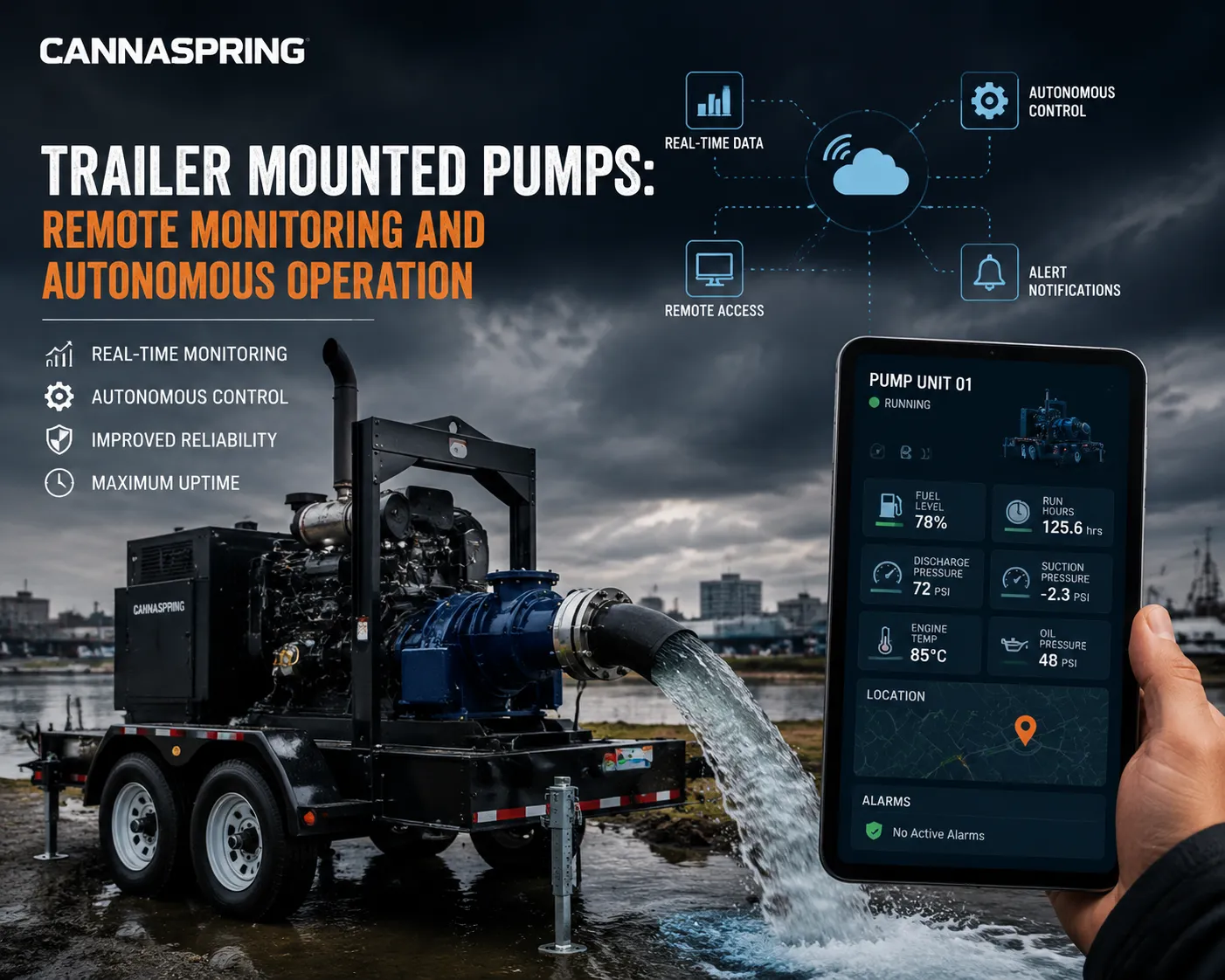
“Remote monitoring” is often used loosely in pump marketing, so it’s worth being specific about what a properly instrumented system tracks and why each parameter matters operationally.
Fuel level and consumption rate. For diesel-powered units on multi-day standby, fuel level is the single most common cause of unplanned downtime — not mechanical failure. A telemetry system that reports fuel level continuously, rather than relying on a physical gauge check, lets a dispatcher schedule a refuel run before the tank runs dry, instead of discovering the shortfall after the pump has already stopped.
Engine and pump operating parameters. Oil pressure, coolant temperature, engine RPM, and discharge pressure are the core health indicators. A drop in discharge pressure at constant RPM typically signals a loss of prime, a clogged suction strainer, or worn wear rings — all conditions that, left unaddressed, lead to cavitation damage. Catching this remotely, in real time, is the difference between a scheduled maintenance call and an emergency pump swap mid-storm.
Run hours and duty cycles. Logged run-hour data feeds directly into maintenance scheduling (oil changes, impeller inspection intervals) and also supports warranty claims, since actual operating hours — not calendar time — typically govern service intervals on diesel engines.
Suction and discharge pressure differential. This is the most direct indicator of pump performance drift over time. A widening gap between expected and actual differential pressure at a given flow rate is an early warning of impeller wear or blockage, often visible in the data weeks before it would be audible or visually obvious on site.
GPS location and geofencing. Beyond theft deterrence, GPS tracking matters for fleets that redeploy trailer mounted pumps across multiple active job sites; it confirms the correct unit is at the correct location and supports asset utilization reporting across a rental or owned fleet.
Alarm and shutdown events. High-temperature shutdowns, low oil pressure trips, and overspeed events should generate an immediate alert rather than sitting in a local fault log that’s only read after the fact.
How the Telemetry Architecture Works
A typical remote monitoring setup on a modern trailer mounted water pump consists of three layers, and understanding each layer helps when evaluating whether a vendor’s “smart pump” claim is substantive or superficial.
Sensing layer. Pressure transducers on suction and discharge lines, a fuel level sender, an engine control module (ECM) already present on most modern diesel engines, and in some configurations a flow meter. The ECM alone often provides the majority of usable data, since most diesel engines built in the last decade already report oil pressure, coolant temperature, RPM, and fault codes over a J1939 CAN bus — the telemetry unit’s job is largely to read that existing data stream rather than add new sensors.
Connectivity layer. This is where deployments genuinely differ, and it’s the layer that determines whether a system works at a remote mining site versus a well-covered municipal one. Cellular (LTE/4G) telemetry units are the default for most North American and European sites, given reasonably widespread coverage. For genuinely remote deployments — rural flood control berms, mine sites, or disaster-response zones where cell towers may themselves be down — satellite connectivity (via networks such as Iridium or comparable low-earth-orbit providers) becomes necessary, at higher per-message cost but with coverage independent of terrestrial infrastructure.
Platform layer. The data lands in a cloud dashboard or, for larger fleets and municipal clients, integrates into an existing SCADA or fleet management system via API. The practical question to ask a vendor here isn’t “do you have an app,” but whether the data is exportable in a usable format for the client’s own reporting and compliance systems, since many municipal and industrial buyers need pump data to feed into broader site monitoring rather than live in an isolated silo.
Remote Start/Stop and Autonomous Control Logic
Monitoring is one half of the equation; the more advanced systems also support remote or automated control, and this is where “autonomous” earns its name rather than being a marketing label for a dashboard.
Level-triggered automatic start/stop. A level sensor in the wet well or sump can trigger the pump to start when water reaches a defined threshold and stop when it recedes, without a human initiating either action. This is standard practice for stormwater and sump applications where water levels fluctuate unpredictably and a pump idling continuously would waste fuel, while a pump that requires manual restart risks missing a rapid rise event overnight.
Remote start/stop override. Independent of automated triggers, a dispatcher or site engineer can start or stop a unit remotely — useful for pre-positioning a pump ahead of a forecast storm surge, or shutting a unit down immediately if a downstream condition (a closed valve, a full discharge point) makes continued operation unsafe or wasteful.
Sequencing across multiple units. On larger dewatering or bypass jobs running several trailer mounted pumps in parallel or in duty/standby configuration, telemetry allows one unit to automatically take over if the lead pump faults out, without waiting for a human to notice the alarm and manually start the backup. This lead/lag logic is standard in fixed pump stations and is increasingly available on mobile trailer fleets used for extended bypass operations.
The Business Case: Where Telemetry Actually Pays for Itself
It’s worth being direct about where the return on this technology comes from, since the upfront cost of instrumentation is a legitimate factor in a purchasing decision.
Downtime avoidance. A single unplanned dry run-out on a hurricane standby unit, or a missed low-oil-pressure shutdown on an unattended bypass pump, can mean hours of site flooding or a sewer bypass failure with regulatory consequences. Telemetry converts these from “discovered after the fact” events into “flagged and actioned within minutes” events.
Labor efficiency across a fleet. For contractors and rental operators running multiple trailer mounted pumps across different job sites, remote monitoring reduces the need for daily physical site visits purely to check fuel and status, freeing technician time for actual maintenance work rather than status checks.
Compliance and reporting. Municipal bypass and SPCC-regulated fuel systems increasingly expect documented run logs, fuel levels, and incident timestamps as part of environmental compliance reporting. A telemetry system that automatically logs this data removes a manual recordkeeping burden and produces a more defensible audit trail than handwritten logs.
Maintenance planning. Fleet-wide run-hour and fault-code data lets a maintenance team schedule service based on actual usage patterns across a fleet, rather than fixed calendar intervals that either over-service lightly used units or under-service heavily used ones.
Where Telemetry Has Real Limits
To keep this assessment credible rather than promotional, it’s worth naming the constraints directly.
Connectivity gaps remain a real issue. Cellular-based systems are only as good as coverage at the specific deployment site; a unit parked in a low-lying culvert or a dense urban basement may have degraded signal even where general area coverage looks adequate on a map. Satellite backup adds cost and isn’t always justified for short-duration jobs.
Sensor data is only as good as sensor maintenance. A fouled pressure transducer or a fuel sender reading incorrectly due to sediment buildup will report false data with the same confidence as accurate data — telemetry doesn’t remove the need for periodic physical verification, it changes how often that verification needs to happen.
Automated control introduces its own failure modes. A level sensor that fails in a “no water detected” state can prevent an automatic start exactly when one is needed; redundant sensing or fail-safe logic needs to be part of the design, not assumed by default.
Not every job justifies the cost. A short-duration rental job running for a few days on an attended site may not need the same level of instrumentation as a 90-day unattended municipal bypass; matching the telemetry package to the actual duty cycle and attendance level of the job avoids overpaying for capability that won’t be used.
Specifying Telemetry-Ready Equipment
- Does the unit report data continuously, or only on a scheduled interval (and if scheduled, how frequently)?
- Is fuel level measured directly, or estimated from run hours and average consumption?
- Can alarm thresholds be customized per site, or are they fixed at the factory default?
- Is the data platform accessible via API for integration into the buyer’s own systems, or only through a proprietary app?
- What connectivity option is used, and has it been validated at sites with coverage conditions similar to the intended deployment?
Closing Note
Remote monitoring and autonomous operation don’t replace sound mechanical design or proper installation — a poorly primed suction line or an undersized pump will still fail regardless of how much data it reports. What telemetry does is shrink the time between something going wrong and someone finding out, which for unattended, critical-duty, or fleet-scale deployments is often the single biggest factor in whether a project stays on schedule or loses days to an avoidable failure.
For contractors, municipalities, and rental fleets specifying equipment for standby, flood control, or extended bypass duty, it’s worth asking any pump supplier — not just about flow and head — but about what happens to that pump’s operating data at 3 a.m. when no one is on site to see it.
Related reading: