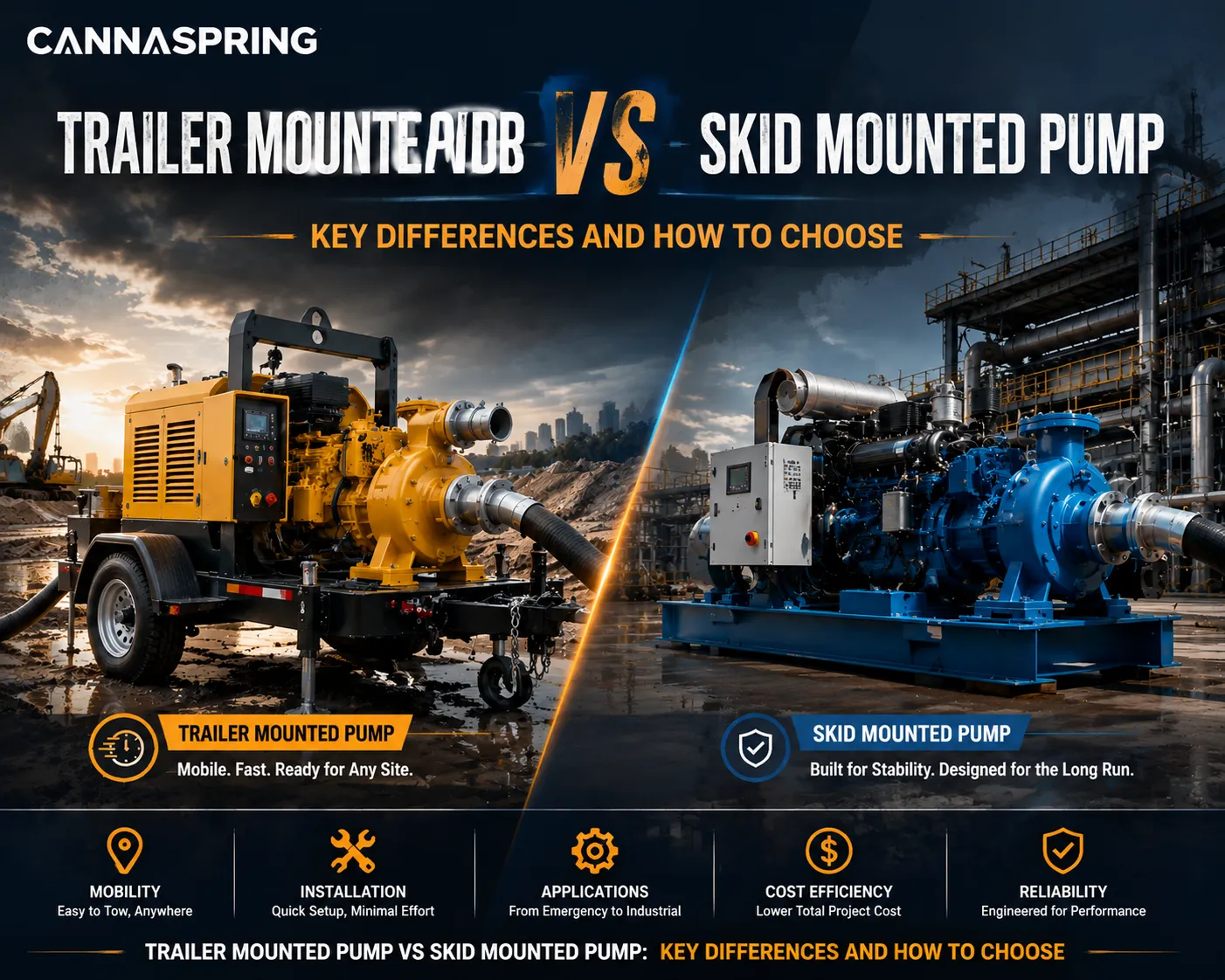
Trailer Mounted Pump vs Skid Mounted Pump
Selecting the right pump configuration is one of the most consequential decisions in a dewatering, drainage, or fluid transfer project. Two configurations dominate industrial and municipal applications: the trailer mounted pump and the skid mounted pump. While both can house the same pump end and engine or motor, the mounting platform changes almost everything about how the unit is deployed, operated, and maintained.
This article compares trailer mounted pumps and skid mounted pumps across mobility, installation, application scenarios, and total project cost, and provides a decision framework for engineers and purchasing managers evaluating which configuration fits their project conditions.
What Is a Trailer Mounted Pump?
A trailer mounted pump is a pump unit — typically driven by a diesel engine, though electric-driven versions also exist — installed on a wheeled trailer chassis with a hitch for towing behind a truck or utility vehicle. The chassis usually includes axles, a drawbar, running lights, and often a fuel tank, control panel, and suction/discharge fittings built into the frame.
Because the pump, engine, and fuel system are pre-assembled on a road-legal or site-legal trailer, a trailer mounted water pump can be towed directly to a job site, positioned, and put into operation with minimal setup. This makes trailer units the standard choice where mobility and rapid deployment matter more than permanent integration into a piping network.
Key characteristics:
- Mounted on a trailer chassis with wheels and a tow hitch
- Diesel engine commonly used for full site independence
- Can be relocated between job sites without lifting equipment
- Designed for rapid deployment in the field
The defining advantage of a trailer mounted pump is that it can go from towing position to running condition in a short window, which is why these units are the default choice for emergency dewatering, flood response, and multi-site construction work.
What Is a Skid Mounted Pump?
A skid mounted pump is built onto a steel base frame (the “skid”) rather than a wheeled chassis. The skid provides structural rigidity and mounting points for the pump, driver, base plate, and sometimes an integrated fuel tank or control panel, but it has no axles or towing hardware.
Because a skid has no wheels, moving it requires a crane, forklift, or flatbed with a winch. This makes skid mounted pumps better suited to installations where the unit is positioned once and then connected into a fixed or semi-permanent piping system, rather than moved from site to site on a regular basis.
Key characteristics:
- Mounted on a welded or bolted steel skid frame
- Relocation requires crane, forklift, or rigging
- Suited to fixed installation or semi-permanent use
- Common in stationary industrial and process sites
Skid units are typically specified when the pump will remain in one location for an extended period, often as part of a larger fixed system such as a treatment plant or cooling water circuit.
Key Differences Between Trailer Mounted and Skid Mounted Pumps
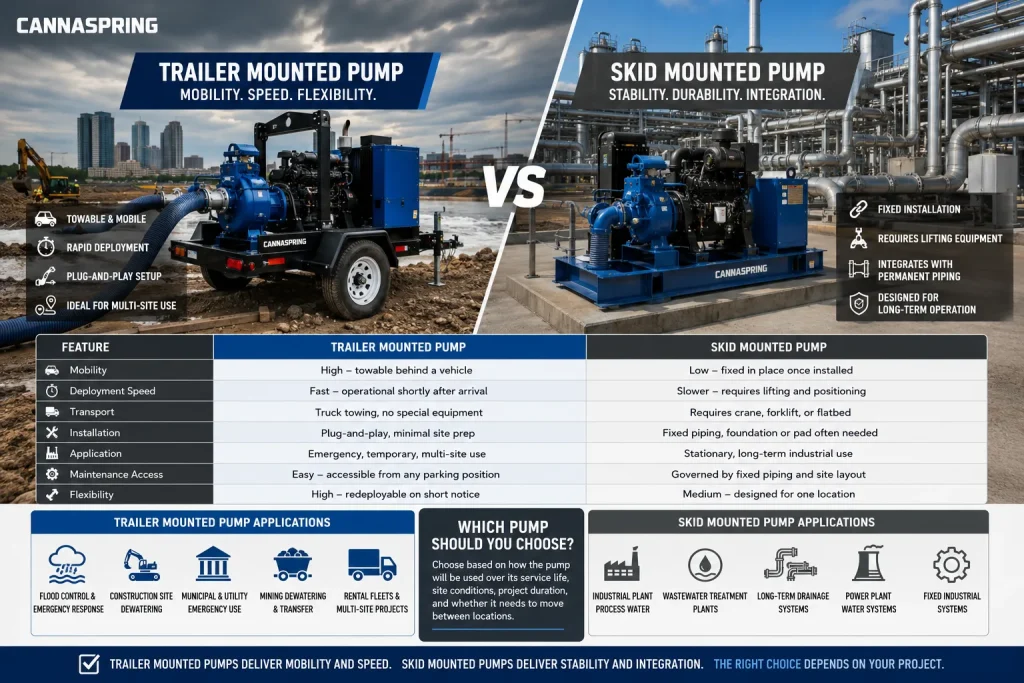
The table below summarizes the core operational differences between the two configurations.
| Feature | Trailer Mounted Pump | Skid Mounted Pump |
|---|---|---|
| Mobility | High — towable behind a vehicle | Low — fixed in place once installed |
| Deployment speed | Fast — operational shortly after arrival | Slower — requires lifting and positioning |
| Transport | Truck towing, no special equipment | Requires crane, forklift, or flatbed |
| Installation | Plug-and-play, minimal site prep | Fixed piping, foundation or pad often needed |
| Application | Emergency, temporary, multi-site use | Stationary, long-term industrial use |
| Power options | Diesel or electric | Diesel or electric |
| Maintenance access | Easy — accessible from any parking position | Governed by fixed piping and site layout |
| Flexibility | High — redeployable on short notice | Medium — designed for one location |
1. Mobility and Deployment Speed
Mobility is the single biggest differentiator between the two configurations. A trailer mounted pump is towed to location, leveled, connected to suction and discharge hose, and started — a process that typically takes a fraction of the time required to crane a skid into position, anchor it, and tie it into fixed piping.
This speed advantage is not incidental. Trailer mounted pumps are preferred in emergency dewatering and flood response scenarios, where the time between mobilization and the pump producing flow directly affects how much water damage or site downtime occurs. Skid mounted pumps, by contrast, are engineered for a one-time or infrequent setup, so their deployment timeline is less critical to overall project performance.
2. Installation Requirements
A skid mounted pump generally requires a crane or forklift for positioning, and in many installations a concrete pad, anchor bolts, or a defined foundation to control vibration and alignment. Once positioned, it is usually connected to permanent or semi-permanent pipework rather than flexible hose.
A trailer mounted pump, by comparison, is close to plug-and-play. The chassis is designed to be self-supporting on outriggers or jockey wheels, suction and discharge connections are typically camlock or flanged hose fittings rather than fixed pipe, and no foundation work is needed. This difference matters most on sites where ground conditions, project duration, or budget do not justify permanent civil works — the trailer configuration allows the pump to be moved on-site as excavation or dewatering zones shift, without re-engineering the installation each time.
3. Application Scenarios
Application requirements are usually the deciding factor in the trailer mounted pump vs skid mounted pump decision, more so than price or flow rate alone.
Trailer Mounted Pump Applications:
- Flood control and emergency storm response
- Construction site dewatering (excavations, foundations, trenches)
- Emergency dewatering for utilities and municipalities
- Temporary mining pumping (pit dewatering, tailings transfer)
- Rental fleets serving multiple job sites
Skid Mounted Pump Applications:
- Fixed industrial plant process water systems
- Wastewater treatment plant transfer and lift stations
- Long-term drainage systems with permanent discharge lines
- Power plant water circulation and cooling systems
- Any installation where the pump is integrated into a fixed piping network for years, not weeks
4. Cost and Total Project Efficiency
Comparing trailer and skid units on unit price alone understates the real cost difference on a project basis. Total project cost should also account for:
- Transport cost — towing a trailer unit with a standard truck versus arranging a crane or low-bed transport for a skid
- Labor cost — a two-person crew can typically position and connect a trailer pump, while skid installation often requires rigging crews and, in some cases, civil contractors for foundation work
- Downtime cost — the time between a pump arriving on site and reaching full operating flow, which is especially significant in dewatering scenarios where standing water is actively causing damage or delaying other trades
In temporary projects, trailer mounted pumps often provide lower total project cost, since the savings in transport, labor, and setup time outweigh any difference in base unit price. For fixed, long-duration installations, a skid mounted pump’s higher upfront installation cost is offset over the life of the system, since it is engineered to run continuously with minimal repositioning.
5. Maintenance and Service Flexibility
Maintenance access is another practical difference that affects operating cost over time.
A trailer mounted pump can be towed to a workshop, or to wherever a service technician is based, for scheduled maintenance or repair — the unit is not tied to fixed piping, so it can be pulled out of service and replaced with minimal disruption to the site. This is particularly useful for rental fleets and contractors managing multiple units across different projects.
A skid mounted pump, once tied into fixed piping, is generally serviced in place. This means maintenance planning has to work around the connected system — isolation valves, bypass lines, or planned shutdowns are often required to take the unit offline. For continuous-duty industrial applications this is standard practice, but it does mean less flexibility in scheduling service work compared with a trailer unit that can simply be swapped out.
Which Pump Should You Choose?
The right configuration depends on how the pump will actually be used over its service life, not just its flow and head requirements. As a practical decision framework:
Trailer-mounted units can also be configured with different pump designs, including mixed-flow pumps for irrigation applications.
Use a trailer mounted pump if:
- The project is emergency or time-critical (flood response, storm dewatering)
- The pump needs to move between multiple job sites
- Site conditions are temporary and permanent piping is not justified
- Rapid deployment and easy towing are operational priorities
- The application is construction, mining, or municipal emergency dewatering
Use a skid mounted pump if:
- The installation is fixed and long-term
- The pump will be integrated into a permanent piping and control system
- The site has infrastructure in place for crane positioning and foundation work
- Continuous, unattended operation over months or years is expected
- The application is a treatment plant, process facility, or industrial water circuit
In practice, many organizations that handle both temporary field work and fixed plant operations maintain both configurations — trailer units for field response and multi-site work, skid units for permanent installations — rather than treating the choice as one-size-fits-all.
Need a Reliable Trailer Mounted Pump for Your Project?
For projects where mobility, rapid deployment, and multi-site flexibility are priorities, a purpose-built trailer mounted pump is generally the more practical engineering solution. As a manufacturer, we produce trailer mounted water pump units in diesel-driven and vacuum-assisted configurations, with chassis, engine, and pump-end combinations that can be customized to project flow, head, and solids-handling requirements — including OEM configurations for rental fleets, contractors, and municipal agencies.
If you’re weighing a trailer mounted pump against a skid mounted pump for an upcoming project, the right choice usually comes down to site conditions, project duration, and how many locations the unit will need to serve.
Contact us to get a recommendation based on your project conditions — including flow rate, head, discharge distance, and site access — and we can help determine whether a trailer mounted or skid mounted configuration, along with the appropriate power and pump-end specification, best fits your application.
Further Reading:
urther Reading: Have you determined that a mobile solution is right for your project? Check out our guide, [How to Choose a Trailer Mounted Pump], to learn how to match flow rate, head, and media requirements to your specific site conditions.