Flood Control Trailer Pump Guide
Flood Control Trailer Pump Guide: How to Choose the Right Pump Before the Water Rises
When floodwaters threaten a property, a construction site, or a municipal infrastructure zone, the margin between manageable damage and catastrophic loss is often measured in gallons per minute. Trailer-mounted pumps have become the go-to solution for emergency flood control precisely because they combine serious hydraulic capacity with the mobility that fixed installations simply cannot offer. But not every pump is right for every flood scenario — and choosing the wrong one under pressure is a costly mistake.
This guide walks you through three layers of decision-making: understanding why flood control demands purpose-built equipment, what trailer pump technology actually delivers, and how to make the right selection for your specific situation.
The Scenario: Why Flood Control Demands Purpose-Built Equipment
Floods Don’t Wait for Infrastructure Urban stormwater systems are typically engineered to handle the 10-year or 25-year storm event. When rainfall exceeds those design thresholds — increasingly common in an era of more intense weather — fixed drainage infrastructure maxes out. Water backs up into basements, underpasses, tunnels, and low-lying construction excavations.
The problem is not always a lack of total pumping capacity in a city or facility. It’s a lack of deployable capacity at the right location at the right time.
Three Flood Scenarios That Drive Trailer Pump Demand
1.Emergency Municipal Response
A heavy rainfall event overwhelms a storm drain network. Low-lying neighborhoods or underpasses begin to flood within hours. Municipal crews need to deploy supplemental pumping capacity to intersections, pump stations, and retention basins — fast. The equipment must be road-towable, quick to set up, and operable without extensive site preparation.
2.Construction Site Dewatering
Excavations for foundations, tunnels, and utilities act as collection basins during rain events. A single overnight storm can fill a 20-foot-deep trench with several feet of water, halting work and compromising shoring stability. Contractors need pumps that can be repositioned as the site evolves and removed when dewatering is complete — trailer-mounted units fit this workflow naturally.
3.Industrial and Facility Flood Defense
Warehouses, data centers, manufacturing plants, and utility substations face severe financial and operational consequences from even minor flooding. Facility managers increasingly pre-position trailer pumps as part of a resilience plan, so that when a flood warning is issued, deployment is a matter of connecting hoses rather than scrambling to source equipment.
The Equipment: What a Trailer Pump Actually Delivers
The Core Architecture
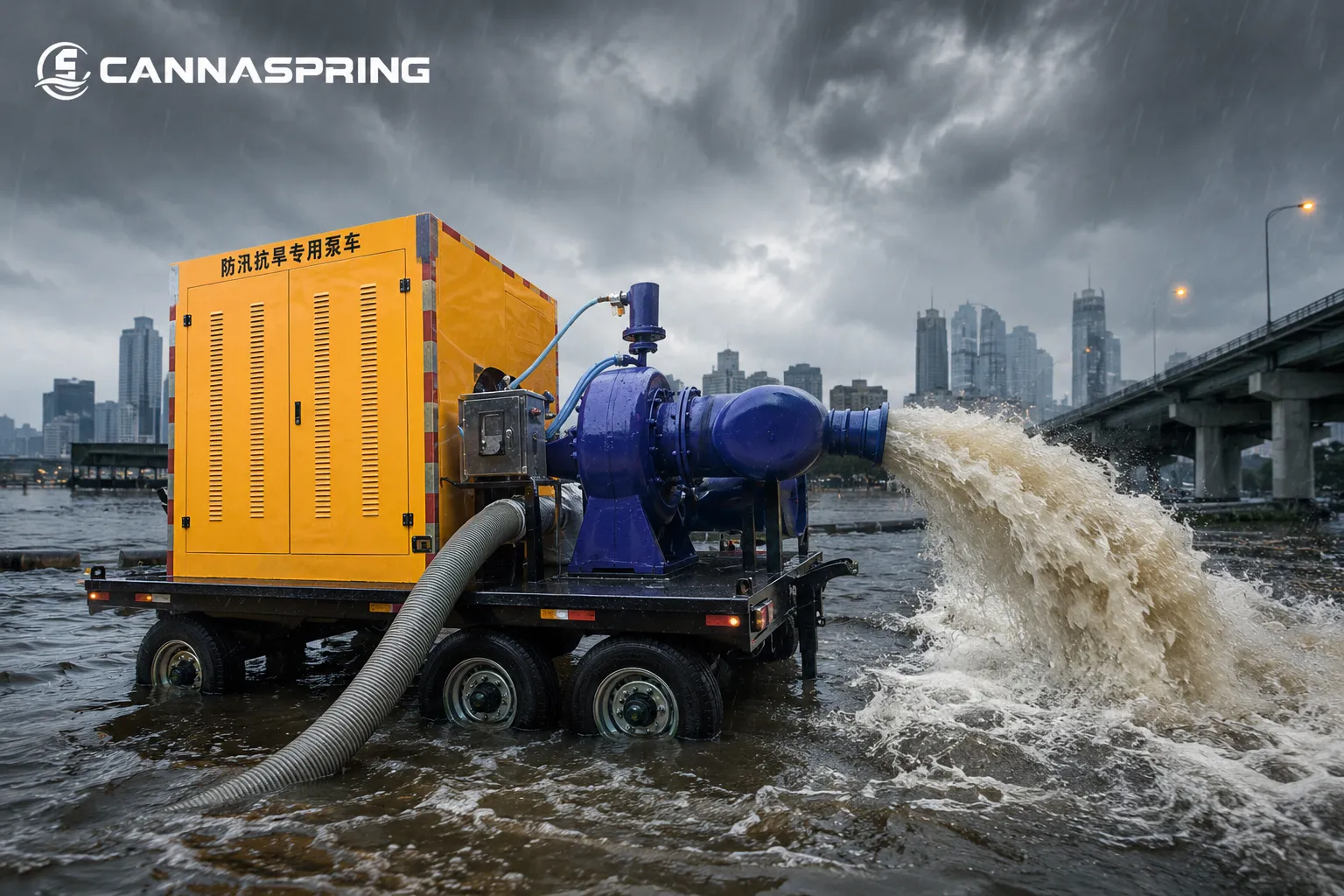
A trailer pump is, at its heart, a self-contained pumping system mounted on a road-legal trailer chassis. The key components are:
The pump end — typically a centrifugal pump for high-volume clean or lightly contaminated water, or a trash pump (semi-open impeller) designed to pass solids, debris, and sediment without clogging. For the most demanding flood applications, hydraulically driven submersible pumps paired with a surface power unit are also trailer-mounted.
The prime mover — a diesel engine is the industry standard for flood control work. Diesel provides reliable starting in wet conditions, extended run times on a single tank, and independence from the electrical grid — which is frequently compromised during the same events that cause flooding.
The trailer chassis — typically single-axle for units up to ~6-inch discharge, tandem-axle for larger units. A well-designed chassis includes a lockable weatherproof enclosure, integrated fuel tanks for 8–24 hours of continuous operation, and lifting points for crane deployment in restricted-access sites.
Performance Parameters That Matter
| Parameter | What It Means in Practice |
| Flow Rate (GPM / m³/hr) | The volume of water moved per unit time — the primary sizing variable |
| Total Dynamic Head (TDH) | The vertical lift plus friction losses the pump must overcome |
| Solids Handling | Maximum particle size the pump can pass without damage |
| Self-Priming Depth | How deep the pump can draw water without priming assistance |
| Fuel Consumption | Runtime between refueling — critical for overnight unmanned operation |
Why Trailer-Mounted Over Skid-Mounted or Submersible-Only?
Skid-mounted pumps require a separate vehicle and lifting equipment for every relocation. Submersible pumps excel in deep sumps but cannot be quickly repositioned across multiple sites during a widespread flood event. The trailer pump occupies a deliberate middle ground: it moves with a standard pickup or work truck, deploys in under 30 minutes with two operators, and provides above-grade engine access for monitoring and maintenance throughout the event.
The Decision: A Practical Selection Framework
Step 1: Define Your Flow Requirement
Start with the hydrology, not the equipment catalog. Estimate your inflow rate — how fast is water entering the area you need to protect? For a construction excavation, this may be calculable from site drainage area and rainfall intensity. For emergency municipal response, it is often a judgment call based on observed water rise rates.
As a general rule, size your pump to move 1.25–1.5× the estimated peak inflow. This buffer accounts for suction losses, discharge line friction, and the reality that flood events rarely behave exactly as modeled.
Step 2: Determine Your Head Conditions
Total dynamic head (TDH) is the sum of:
- Static head — the vertical distance from the water surface to the discharge point
- Friction losses — resistance in hoses, fittings, and discharge piping
Many flood control applications involve low static head (under 20 feet) but significant friction losses in long discharge runs. Always model the full system, not just the lift. A pump rated at 5,000 GPM at 10 feet of head may deliver only 3,500 GPM when you add 300 feet of 6-inch discharge hose to the calculation.
Step 3: Assess the Water Quality
This is the most commonly overlooked selection criterion.
Clean stormwater runoff from a paved surface → standard centrifugal pump is appropriate.
Runoff carrying leaves, construction debris, sand, or small gravel → specify a trash pump rated for solids passing at least 3 inches in diameter.
Wastewater, sewage bypass, or heavily silted floodwater → consider a vortex impeller pump or hydraulically driven submersible pump that avoids impeller contact with solids entirely.
Running the wrong pump in the wrong water type is the single most common cause of impeller damage and mid-event failure.
Step 4: Consider Deployment Logistics
Ask yourself:
How will the trailer reach the site? If access is through a parking structure, a narrow alley, or over soft ground, trailer dimensions and ground clearance matter as much as pump performance.
How long will it run unattended? Select a unit with integrated fuel capacity sufficient for your longest anticipated continuous run, plus a safety margin.
Who will operate it? Trailer pumps intended for emergency use by non-specialist personnel should have simplified controls, clear labeling, and automatic low-oil/high-temperature shutdowns.
Step 5: Match to a Pump Class
| Application | Typical Flow Range | Recommended Configuration |
| Residential / small commercial | 500–1,500 GPM | 4-inch diesel trash pump, single-axle trailer |
| Municipal underpass / tunnel | 2,000–6,000 GPM | 6-inch or 8-inch diesel centrifugal or trash pump |
| Construction site dewatering | 1,000–4,000 GPM | 6-inch trash pump or hydraulic submersible |
| Large-scale emergency response | 6,000–20,000+ GPM | High-volume multi-stage or multi-pump trailer system |
From Pump Class to CANNASPRING Configuration
Once you’ve sized your flow, head, and water quality using the framework above, here’s how those variables map to CANNASPRING’s trailer pump line:
| Flood Requirement | CANNASPRING Configuration |
| High-volume clean water transfer, low head (retention basin fill, temporary municipal supply) | CHWY Series — 100–5200 m³/h, 4–20m head. Not suited for debris-laden water. |
| High head dewatering with debris or solids (excavation flooding, underpass drainage) | ZBCY Series — up to 3000 m³/h, up to 120m head, handles solids to 75mm |
| Muddy, debris-heavy sites requiring frequent unclogging or servicing | SCPY Series — 80–600 m³/h, 7.5–31m head, rear-pull design for fast maintenance |
The Bottom Line
Selecting a flood control trailer pump is not a catalog exercise — it is a system engineering problem that starts with understanding the water, the site, and the operational realities of a flood event. The right pump, deployed correctly, can protect millions of dollars in assets and keep critical operations running through conditions that would otherwise shut them down entirely.
Define your flow. Know your head. Respect the water quality. Plan the logistics. Everything else follows from those four decisions.